Blog Image

Tankar

Te och tro

2025 Posted on Sat, November 01, 2025 17:07:04

Den självbiografiska romanen Michail handlar om vänskapen mellan den rumänske författaren Panait Istrati och den ryske adelsmannen Michail Kazanskij. När de möttes i början av 1900-talet var Michail utfattig och arbetade som hjälpreda till en sockerbagare i Istratis födelsestad Braila.

Michail är sluten och hemlighetsfull, men tinar gradvis upp i samspel med den impulsive och känslosamme Istrati. För mig var det nödvändig själslig näring att mödosamt översätta romanen till svenska under några månader 2006, med min stolpiga skolfranska och ett lexikon till hjälp.

Här är ett charmigt avsnitt som kan läsas fristående. Det handlar om den gammaltroende ryske innehavaren till ett tehus i Braila. Jordnära, friskt och högstämt på samma gång. Vinjettbilden visar gammaltroende ryssar som korsar sig med två fingrar framför sin kyrka i den rumänska byn Sarichioi.

Efter att ha varit ute i Brailas hamn under ett våldsamt åskregn en het sommardag, styr Michail Kazanskij, Panait Istrati och den gemensamme vännen Samoila Petrov kosan till tehuset för att hämta andan och låta kläderna torka. Istrati kallar sig själv Adrian Zografi i romanen.

Ett avsnitt ur romanen Michail

Hur kunde han, denna skeptiker till Michail, betvivla till och med det renommé som gospodin[1] Procops ceainic[2] eller ceainărie, hade överallt i Brăila? För detta renommé handlade inte bara om teets kvalitet, som, hos Procop, var ”äkta Poppoff” (då man uttryckligen begärde det och betalade fem bani extra). Det handlade inte heller om sockret – detta eviga trätoämne som fick mången god gäst att plötsligt byta ceainic för att man serverat honom ”mjöligt socker” – och här blir jag tvungen att göra en liten utvikning.

Varför skydde man ”mjöligt socker” som pesten? För att i Brăila, liksom i det heliga Ryssland, dricker man inte te som i Paris eller London. Där är det fritt fram att hälla socker i den ljumma saften och till och med att smutsa ner den med en droppe mjölk eller två, eller att låta den vara som den är och svälja den – kluck! – som man sväljer ner ett laxermedel, eller också hålla till godo med den för att vara artig och sedan gå – med ett ”tack så mycket” – utan att ha rört den. I Rumäniens näst största hamnstad dricker invånarna te på ett helt annat sätt. Dessa invånare – om de så är get-beget[3] nationalister eller lipoveanska[4] pravoslavniks[5] med skägg som Tristan Bernard[6], med långa stövlar som kloakarbetare och vida långrockar, i vars fickor de förvarar sina obligatoriska glas som de alltid släpar runt på, tunga som stenar, och som de använder på smutsiga krogar för att hälla upp sin rena vodka i efter att först ha korsat sig otaliga gånger – dessa invånare är, framför allt, stora tedrickare. De dricker det från morgon till kväll för dess många goda egenskapers skull, som apéritif, som närings­medel, för att smälta maten, som laxativ, för att motverka lös mage, för att pigga upp, för att ge ro och som urindrivare. Man dricker det om vintern för att värma sig, om sommaren för att svalka sig, och man intar mellan två och fyra liter om dagen som ingenting. Men vad gör man med allt detta vatten i magen, kan man undra. Nå, man dricker glas efter glas i allsköns ro och sedan, på samma oskyldiga sätt, går man ut på gatan och pissar på trottoaren medan man torkar sig i ansiktet och ibland vänder ryggen till då en vän kvinna råkar passera förbi. På så vis reglerar det hela sig själv. När tarmarna genomsköljts av så mycket vatten börjar de knorra av hunger, och ofta nog drabbas också ens bronker av kylan när man vintertid går ut ”för att göra bärnstensgula hål i den obefläckade snön”.

Och för att man ska kunna dricka så mycket te utan att det blir för dyrt, med tanke på det upptrissade sockerpriset och den ringa lönen, så har man tillgripit ett trick: efter att ha delat sockret i pyttesmå tärningar med hjälp av ett redskap som kallas sifci, dränker man först in den lilla sockerbiten i citron och placerar den sedan behändigt mellan kinden och käken, där den tappert håller stånd mot alla munfullar kokande vätska som stryker förbi utan att gå alltför illa åt den, och på så vis når man glasets botten medan man fortfarande har kvar en svag smak av det dyrbara näringsämnet i munnen. Därborta kallas detta att dricka teet prikutsk. Det är därför man undviker det ”mjöliga sockret”, som teet snabbt sköljer bort, ”som om det vore strösocker” och efterfrågar det som är ”hårt som glas” och självlysande om natten, precis som de tändstickor man förr använde till att förgifta sig med.

De två bitar som utgjorde en ”halv portion” – cirka femtio gram – sågades ut från ett sockerblock på fem kilo av ägaren själv, för det behövdes ett tränat öga och stor precision för att få bitarna nästan exakt lika stora och undvika att kunderna skulle tycka att vissa av dem var för små för dem själva och för stora för bordsgrannen. Men sockret är en outtömlig källa till missnöje. Även om sockerblocket så är tredubbelt raffinerat kan man inte komma ifrån att det är hårdast i toppen och ”mjöligast” i botten. Och den stackars uppassaren får springa som en skottspole mellan den vresige kunden och värdinnan vid disken, som till slut inte vet var hon ska bli av:

– Fru-u-un! Herr X vill ha en bit från toppen!

– Hör nu, herr X … Ni vet så väl att ett sockerblock inte bara består av en topp!

– Ja, frun, men det består inte bara av en botten heller!

I detta läge ingriper gospodin Procop hastigt, för han ser och hör allt; han sätter sig in i saken, drar sina slutsatser och erbjuder kunden en bit från överdelen eftersom han vet att denna kund är resonabel; det händer nämligen också att han kör folk på porten.

*

Men – liksom teet, som inte har sin like även om det inte uttryckligen är ”Poppoff” – så har alla dessa förhållanden kring det utomordentliga sockret, servicen och utrustningen (klanderfria), lokalen (stor, ren och väl upplyst), vattnet (hämtat från två kärl varav det ena står i ständig kokning), alla dessa företräden sammantagna skapar inte det renommé som gospodin Procops ceainic har i lika hög grad som gospodin Procops egen person.

Och platsen blev helig …

För människan – till och med den tarvligaste – är ett djur som inom sig omedvetet bär fröet till den universella fullkomning som mänskligheten mot sin egen vilja strävar mot. Det är därför som grovarbetaren, som nöjer sig med ett litet hörn av ett bord hos Procop, vet att den jättelike lipoveanen med sitt klara öga och sitt välkammade skägg gör mycket tydlig skillnad mellan folk och folk. Han vet att priset och förtäringens kvalitet är densamma för alla, men att värdens goddag sannerligen inte är det. Och att få ta emot ett sådant ”goddag” är det han i sin råhet längtar allra mest efter, tack vare det ädla frö han bär inom sig utan att veta om det.

Denne grovarbetare fruktar Procop lika mycket som han älskar honom och han tigger om ett uns av hans aktning, ty han har sett den stolte lipoveanen lämna sin disk – där han står rak som en domare bredvid sin sittande fru – för att med värdiga steg gå och skaka hand med någon gäst som nyss har kommit in, föra honom till en bra plats, själv torka av bordet, av ren artighet – för borden är rena – samtala med honom en liten stund och sedan med sin ägarstämma beställa det som han vet att gästen brukar ta:

”En halv till herr X!”

Med detta vill han säga, både till uppassaren vid buffén och till alla andra, att aktningen, den är huvudsaken, sedan kommer bagateller som att servicen ska vara fullgod, att sockret och citronskivan ska vara utan anmärkning.

Men det betyder framför allt att den kund som på detta vis åtnjuter gospodin Procops aktning inte gör de saker han själv gör, han, denna buffel med sin tusenåriga råhet: han snor inte den tidning man har gett honom att läsa, han spottar inte på golvet, häver inte ur sig grovheter till damerna i lokalen, dunkar inte i bordet som en fåne för att tillkalla kyparens uppmärksamhet, han pissar inte på gatan, han försöker inte stjäla sifcin eller ta de bani som en gäst just lämnat efter sig på bordet bredvid innan han gick ut, eller försvinner utan att betala under förevändning av ett ”nödvändigt ärende” som tillåter honom att gå ut på gården.

Han själv, människan utan blygsel, han gör allt detta. Han kan inte låta bli att göra det eftersom det är en del av hans natur – liksom det skamlösa utnyttjandet och det kollektiva brottet är en del av naturen hos denna andra människa utan blygsel som befinner sig på toppen av den sociala stegen och behärskar den med all sin grymhet. Men trots att han brutalt hålls kvar i okunskap, att han sorgligt nog är utlämnad åt sina instinkter och aldrig får hjälp att resa sig, så hjälper han sig själv. Nej, han hjälper inte sig själv, han lyder. Han reagerar på de vibrationer som surdegen som jäser i hans själ ger upphov till. Och när han ser att gospodin Procop ärar den oklanderliga, propra och hänsynsfulla människan, så öppnar den stackars uslingen sina ögon; han beundrar fromt, ler, blinkar, spottar av vällust och sjunker tillbaka i sitt hörn: dessa hedersbetygelser är inte ämnade för honom, men han njuter ändå, för han är dagens grova förfader till morgondagens klanderfria, propra och hänsynsfulla mänsklighet. Han vet det inte. Och Procop, som är en pionjär för det andliga framåtskridandet, vet heller inte att det är detta han är. Inte heller han gör annat än att underkasta sig, men under föregångarens lag.

På sommaren står han på sina stadiga ben mitt bland de dussintals borden som är utspridda på trottoaren, med naturligt höjt huvud och föraktfull blick, och betraktar spektaklet som utspelar sig på de närbelägna ceainicarnas uteserveringar, där gästerna svär, klappar sig på baken, fjärtar högt, tar sig i skrevet, ofredar kvinnorna – allt medan ägarna roat ser på. Vid sådana tillfällen inser inte gospodin Procop vilket inflytande han utövar på sin lilla värld bara genom att vända bort huvudet, efter att ha behärskat en stark lust att spotta av avsky, och med ett värdigt uttryck säga till en gäst som han högaktar:

”Ibland tror jag nästan att Gud har satt människan på jorden bara för att visa djuren hur mycket bättre och finare de är än vi!”

Procop gör bara detta, säger bara detta. Genast känner sig den simple arbetaren lycklig över att befinna sig på den rättfärdige lipoveanens terrass i stället för att vara bland dem som han föraktar så kungligt och inte släpper innanför dörren. Och om söndagarna, när Procop beger sig till gudstjänsten i den ryska kyrkan klädd i sin svarta långrock, jättelik som han själv, omgärdad av sin trinda fru och deras sex barn, pussiga i ansiktet och iklädda brokiga kläder i karmosinrött, citrongult och ultramarin – då reser sig den övertygade ateisten Samoilă Petrov när den ärbara familjen går förbi; han bugar sig fromt och känner en oemotståndlig lust att följa i gospodin Procops fotspår, att följa honom dit han inte har varit sedan han var barn.

Detta är vad dragningskraften hos Procops ceainic består av: den är inte byggd av hårt socker utan av en vacker mänsklig tro. Man vet det inte. Man underkastar sig denna tro. Och den hackar outtröttligt på vår vanäras klippa, den främjar grodden hos den nya värld som närmar sig längs krokiga vägar från sina avlägsna himmelsdjup. Den har inget behov av att predika för att fullgöra sin uppgift: den tvingar några att bli föredömen och andra att ta efter de förra. Och dess metoder är lika enkla som dagsljuset: gospodin Procop anordnar inga välmenande konferenser eller kommer med bittra förebråelser; till att börja med lever han ett värdigt liv och sedan visar han sin aktning för dem som respekterar hans etablissemang – och han gör det på enklast möjliga sätt: genom att hälsa på dem med större värme och ta större artig hänsyn till dem.

På detta vis kom gospodin Procop dem till mötes när han såg Samoilăs vördnadsbjudande huvud avteckna sig i dörren – denne lät artigt Michail och Adrian gå in före honom – och sade till Petrov:

– Det har inte gått en minut sedan jag frågade kyparen som brukar servera er om ni redan hade druckit ert kvällste.

Och då han sett närmare på dem:

– Men ni är ju blöta in på bara skinnet!

– Därför tänkte jag fråga er, sade målaren, om vi kunde få slå oss ner i det lilla rummet nära tekokarna i en timmes tid: då hinner kläderna torka medan vi dricker vårt te.

Sedan tillade han på ryska:

– Jag rekommenderar er gospodin Michail. Om han kommer hit ensam eller i sällskap med Adrian, som ni redan känner, så ber jag er att behandla honom på samma sätt som ni behandlar mig.

Procop bugade sig på ryskt vis och skakade Michails hand utan att ta notis om hans eländiga yttre. Sedan visade han dem till det efterfrågade rummet och ropade med sin allvarsamma stämma:

– En portion Poppoff ”med tre” (glas) till herr Samoilă!

Och alla tittade upp.

Teförsäljare i Braila. Vykort från början av 1900-talet.


[1] Gospodin Herr (ryska). Under tsartiden var tilltalet förnämt och användes mest till adelsmän och höga tjänstemän. Den rumänska motsvarigheten är gospodar. Används ofta i betydelsen “god husbonde” eller “bra chef”.

[2] Ceainic Tekanna. Används här i betydelsen tehus.

[3] Get-beget Tvättäkta, genuin. Sammansättningen i texten kan översättas med “ärkenationalister”.

[4] Lipoveaner Gammaltroende ryssar som förföljdes och därför emigrerade till södra Ukraina och östra Rumänien. De gammal­troende vägrar att erkänna de förändringar i den ortodoxa gudstjänstordningen som infördes av patriarken Nikon 1652.

[5] Pravoslavnik Rysk-ortodox, ryss (ryska).

[6] Tristan Bernard (1866–1947). Fransk författare och humorist.


Phoolan Devi: en legendarisk indisk banditledare och en obändig själ

2025 Posted on Thu, September 18, 2025 21:51:58
De första fotografierna av Phoolan togs i samband med hennes kapitulation år 1983.

Phoolan Devis självbiografi är för mig en klenod. Jag minns fortfarande när jag köpte den i bokhandeln vid järnvägsstationen i Lund år 1996 då den nyss kommit ut i svensk översättning.

På svenska heter biografin Jag, Phoolan Devi – Min egen berättelse. Den ger uttryck för en elementär livsinstinkt, en bultande kraft som omöjligt kan acceptera ondsinta handlingar och resignera inför missförhållanden. Hennes skildring speglar människan och världen på ett så naket sätt att man för ett ögonblick kan undra vad floden av andra böcker egentligen tillför.

Naturligtvis återger berättelsen just Phoolans värld, sedd genom hennes eget temperament och öde. Det finns andra temperament och öden att ta del av. Men liksom hos många andra människor med drabbande erfarenheter förefaller allt nonsens, alla spetsfundigheter och poser ha bränts bort. Kvar blir en enkel klarhet som gör berättelsen universell.

Det enkla och direkta står i kontrast till de romantiserade bilder som målats upp av Phoolan Devi som legendarisk banditledare, de roller hon tilldelats och de omdömen av alla sorter som fällts över henne.

Hon föddes år 1963 i den lilla byn Gorha Ka Purwa vid floden Yamunas strand i den indiska delstaten Uttar Pradesh. Hon tillhörde den lågt stående kasten Mallah och hennes familj var mycket fattig eftersom hennes kusin Mayadin efter ett arvskifte vägrade dela med sig av den jord som tillhörde släkten.

Redan som barn ansågs Phoolan vara uppstudsig och besvärlig. Hon vägrade att böja sig för orättvisor och förödmjukelser i vardagen. När Phoolan som 11-åring giftes bort med en medelålders änkling på annan ort såg Mayadin till att hon omedelbart flyttade hem till denne man, som ett sätt att bli av med henne, i strid med sedvänjan att låta gifta flickor bo kvar i föräldrahemmet tills de började bli vuxna. Mannen förgrep sig på henne och misshandlade henne.

När Phoolan till slut kunde återvända hem var hon en paria eftersom hon övergivits av sin man. Ingen annan man ville gifta sig med henne, medan desto fler ville ta sig friheter med henne. Phoolan accepterade inte sin roll och situationen eskalerade tills ledande män i byn lejde ett banditgäng för att kidnappa henne och en gång för alla bli henne kvitt. Det var så hon blev bandit.

Phoolan Devis självbiografi går att få tag på i antikvariat och går att köpa ny på engelska. Här ger jag några smakprov och sätter dem i sitt sammanhang. Det är en sorglig och brutal berättelse, men också ömsint och vardaglig, berättad med en röst man gärna lyssnar till.

När Phoolan Devi och hennes banditgäng kapitulerade år 1983 efter en utdragen förhandling med myndigheterna var hon knappt tjugo år gammal. Hon blev villkorligt frigiven år 1994 och överöstes då av uppmärksamhet. Många artiklar skrevs om henne, även i västerlandet. En spekulativ film om Phoolan Devis liv, The Bandit Queen, hade premiär samma år. Phoolan Devi godtog aldrig filmen. Hon sade att den hade fått många saker om bakhuvudet och helt enkelt inte handlade om henne.

Phoolan Devi gavs chansen att berätta sin egen historia då ett franskt förlag sökte upp henne och erbjöd henne att författa sin självbiografi. Phoolan Devi kunde varken läsa eller skriva och visste knappt vad en bok var för någonting. Hennes enda referensram var den heliga hinduiska skriften Ramayana, som brukade bäras fram under andakt till en samlingsplats under ett stort träd i hennes hemby och högläsas för alla bybor.

Phoolan tackade ändå med glädje ja till att författa sin självbiografi, med orden att det skulle innebära en skillnad lika stor som ”mellan jorden och himlen” att själv berätta om sitt liv jämfört med att höra andra göra det. Hon dikterade biografin på kassettband. Inspelningen skrevs ut till ett manuskript på 2 000 sidor, som två författare sedan skar ned och formade till en bok. Denna lästes upp för Phoolan, som fick godkänna och signera varje sida med sitt namn, som var det enda ord hon kunde skriva.

Phoolan Devi (till höger) med sin mor (i mitten) strax innan Phoolan kapitulerade i februari 1983.

Självbiografin inleds med en vardagsnära skildring av uppväxten i den lilla byn, med en kolerisk men i grunden kärleksfull mor, en vek och ömsint far, samt flera syskon.

När jag var liten älskade jag doften av våt jord och lera. Jag tog händerna fulla av tjock, röd lera och stoppade den i munnen. Mor grälade på mig och till slut blev hon tvungen att binda ihop mina händer för att jag skulle sluta äta jord. Den röda jorden gav näring åt grödan och leran täckte våra väggar. Den luktade oändligt gott. Men den gick inte att äta.

Phoolans temperament verkar ha följt henne från späd ålder.

Jag försökte vara undergiven, som min far sade åt mig, men jag kunde inte. Det fanns för mycket vrede inom mig.

När Phoolan sluppit ur klorna på Putti Lal, den man hon blev bortgift med som elvaåring, började livet i byn att bli outhärdligt. Män ur thakur-kasten, som var hennes plågoandar livet igenom, fattade posto utanför familjens dörr, skrek glåpord och kom med skamliga förslag. Phoolans mor fick skicka i väg henne till hennes mormor i en annan by.

Mormor var jag innerligt fäst vid och hennes kärlek och vänlighet hjälpte mig att börja leka igen med mina små kusiner och förvisa mina hemska minnen till en plats djupt nere i medvetandet. Min mörkrädsla släppte, men fortfarande drömde jag mardrömmar då och då; jag drömde att jag blev levande begravd eller låg på botten av en brunn och ropade på hjälp. Då kom mormor och väckte mig och när jag såg hennes bräckliga lilla gestalt bredvid mig blev allting bra igen.

Det sexuella våldet löpte som en svart tråd genom Phoolans liv. När hon var sexton år gammal blev hon oskyldigt anklagad av sin kusin Mayadin att ha begått en stöld i hans hem. På polisstationen i den närbelägna staden Kalpi blev hon misshandlad och gruppvåldtagen. Det var varken första eller sista gången.

Hur många de var kunde jag inte säga. De såg inte mitt ansikte och jag inte deras. Mina ögon var hårt slutna som på en stenstaty. Jag var av sten.

Efter övergreppen fördes Phoolan ut till sin far:

[S]å fort de hade gått ville han veta vad de hade gjort med mig.

’Ingenting’, sade jag. ’Ingenting. De frågade bara en massa och så slog de mig igen.’

’Det var mer än så, Phoolan. Det syns på dig.’

’Nej. De gjorde ingenting’

De hade varnat mig och sagt att om jag skrek eller ropade på hjälp skulle de köra upp chilipeppar i mig så att jag verkligen fick någonting att skrika för. Och sedan hade de skrattat.

’Ingenting alls’, sade jag gång på gång. ’De gjorde ingenting alls.’

Han måste ha trott att jag var förryckt. Jag kunde inte gråta. Jag kände ingenting alls. Min kropp existerade inte längre. Den var inte längre en del av mig, den betydde ingenting, den var inte längre min… Jag vet inte hur kroppen lyckades hålla sig på benen. Den rörde sig utan mig, vandrade runt cellen, satte sig, reste sig igen och fortsatte vandringen runt, runt…

’Lugna dig, Phoolan. Vad är det? Vad gjorde de med dig? Berätta nu…’

’Ingenting.’

Men jag kunde inte vara stilla. Jag dunkade pannan i väggen, först på ena sidan av cellen och sedan på den andra och sedan återigen, för nu började jag minnas vad de hade gjort, nu återvände minnena, det ena efter det andra: smärtan, polisernas grymtningar och förolämpningar. Jag ville se dem stekas levande. Jag ville höra dem tigga om nåd.

När hon kördes från polisstationen till domstonen på flaket till en lastbil började hon reflektera:

Där satt jag nu, omgiven av polismän. Fortfarande var jag bara barnet, inte mer än sexton år gammal, och jag var bara en fattig, okunnig flicka av lågkast som arbetade på åkern. Varför allt detta hat? Varför allt detta våld? Medan vi åkte längs vägen och jag såg skymningen komma började jag undra om det var själva styrkan inom mig de alla ville knäcka, just den styrka som gav mig viljan att hämnas och framför allt viljan att till varje pris överleva.

Till slut blev Phoolan frikänd och fick komma hem, eftersom hennes advokat lyckades skaffa fram bevis på att hon varit på sjukhuset med sin storasyster då brottet skulle ha begåtts.

Min oxe hade inte blivit utfodrad på hela tiden jag var borta och såg mycket trött och vemodig ut. Honom hade jag skött om ända sedan han var kalv och nu när han såg mig fylldes hans ögon av tårar som rann ned över mulen. Sedan slickade han min hand. Det var som om han förstod vad jag hade genomlidit. Och han hade också haft det svårt, för ingen hade tagit hand om honom och nu var han så svag att jag lutade kinden mot den grova hårfällen på hans nacke och grät jag också.

Sedan hämtade jag vatten åt honom och gick för att skära lite gräs. Jag hade inte mod nog att visa mig i byn. De som hade sett mig komma hem hade inte kunnat låta bli att lägga näsan i blöt.

’Så hon har förändrats!’ sade en av dem.

’Gud allena vet vad de har gjort med henne… Berätta Phoolan! Hur var det i fängelset?’ frågade en annan. Och en tredje sade med ett hånflin: ’Tycker du om karlar nu då, Phoolan? Hur många har du legat med?’

I deras ögon var jag en fallen kvinna. Ryktet om misshandeln, fängelsevistelsen och allt jag hade fått genomgå hade spritt sig. Mina väninnor undvek mig. De ville inte tala med mig. Men alla skvallrade om mig.

Min oxe frågade ingenting och satte sig inte till doms över mig. Han hade trofast väntat på mig och när jag kom tillbaka grät han över mig.

Hemma i byn blev Phoolan jagad av män i alla åldrar. Hon vågade inte vara hemma på natten och sov ibland uppe i ett träd. Hela familjen trakasserades. De fick inte hämta vatten i brunnen och fadern gavs inget arbete. När han väl gavs något uppdrag fick han ofta ingen lön.

En dag blev jag alldeles rasande på det. Far och jag var dödströtta efter att ha tröskat hirs åt en man som vägrade att betala oss efter arbetets slut. Han sade att Mayadin hade sagt åt honom att hålla inne vår dagslön. Jag ryckte åt mig min skära och började gallskrika åt honom.

Din förbannade hund, det är klart att du ska betala oss! Hur vågar du låta Mayadin bestämma över våra pengar? Det är vi som har arbetat, inte Mayadin. Nu betalar du, annars skär jag dig i bitar!

Mannen betalade.

Vi bar hem hirsen och gick ned till floden för att skölja den. Jag var fortfarande rasande men också full av triumf, och bestämde mig för att passa på att bada. Mor sade åt mig att vara försiktig eftersom strömmen var stark. Jag sade att nu var jag inte rädd för någonting längre, och så tog jag av mig sarin och hoppade i vattnet. Mor måste ha trott att jag tänkte dränka mig. Men jag var bara lycklig, svindlande lycklig. Jag hade förstått att eftersom de andra också levde i skräck behövde jag ju bara skrämma dem jag med! Eftersom de använde våld skulle jag ta till samma medel.

Att Phoolan passerat en gräns och började slå tillbaka med all kraft hon hade kan ha bidragit till att sarpanchen, ordföranden i byrådet, till slut lejde ett banditgäng för att föra bort henne.

Gänget som kidnappade Phoolan hade två ledare, Baboo och Vikram. Baboo ville gång på gång våldföra sig på henne, medan Vikram försvarade henne och behandlade henne respektfullt.

Phoolans närvaro ställde en rivalitet mellan de två ledarna på sin spets. Konflikten slutade med att Vikram använde Phoolan som verktyg för att ta kål på Baboo. Vikram gav till synes med sig och beordrade Phoolan att gå och lägga sig hos Baboo, varpå Vikram helt sonika sköt ihjäl honom i försvarslöst tillstånd när han trodde att han nått sitt mål.

Ett förtroligt förhållande uppstod mellan Phoolan och Vikram och de arrangerade banditbröllop i djungeln.

Det var både ljuvt och plågsamt att utan skam och utan rädsla kunna tala med den här mannen som jag knappast kände, som min familj inte kände och som hade rövat bort mig från dem. Han var respekterad av så många människor och han var så ståtlig att jag knappast vågade tro att han tillhörde samma kast som jag. Eller att jag nu tillhörde honom.

Han kysste mig. Det var första gången en man kysste mig. Det var också första gången en man frågade om jag var rädd, och om jag var lycklig.

Jag vet inte om detta ögonblick av frid och trygghet var detsamma som kärlek. Men många år senare när jag tänkte på den dagen frågade jag mig varför denne man, om han nu verkligen älskade mig, inte helt enkelt lät mig gå? Då hade jag inte behövt bli bandit. Då skulle jag ha haft en egen familj, barn, kreatur och en egen härd.

Eller också skulle jag ha dött, och då skulle allt det där inte ha spelat någon roll.

Livet som bandit var hårt för en tonåring. De var hela tiden i rörelse för att undgå polisen, med nattliga ilmarscher följda av några timmars sömn var det föll sig i skogen. Vid ett tillfälle slogs Phoolan av hur oberörda männen i gänget var av allt detta, hur de skrattade och spelade kort efter dagar utan mat och vatten. Men livet ute i naturen hade också poetiska och vackra sidor.

Vikram hade gett mig en kam att reda ut håret med och när han märkte att jag inte vågade bada tillsammans med honom eftersom jag var rädd att han skulle komma mig för nära i vattnet gick han ett stycke bort. När han kom tillbaka satt jag på stranden och kämpade med tovorna i mitt hår. Det hade redan börjat torka och lockade sig i värmen.

’Så vackert hår du har’, sade han.

Nu började solen sjunka. Den kolossala, orangefärgade bollen var på väg ned i sjön och det gjorde mig så vemodig.

’Vad tänker du på?’

’Solen kommer ju att dö i vattnet.’

’Varför tror du det?’

’Det finns ju inget mera land, detta är världens ände, så nu kommer solen att drunkna.’

Det var första gången jag såg solen gå ned över ett vatten så stort att man inte såg motsatta stranden. Men männen begrep inte att min värld hade klara gränser, att den slutade där jag inte kunde se den längre. Båda skrattade och Bare Lal sade: ’Tror du att detta är världens ände? Vad har vi under fötterna då? En värld som växer uppåt?’

Jag försökte förtvivlat fatta vad de menade. Slättlandet och floden var allt jag kände till. Ända sedan jag var liten hade jag sett solen dö på andra sidan av Yamuna och en ny sol födas nästa morgon. Jag önskade att jag hade hållit tyst.

Phoolans elddop som bandit kom när hennes nyfunna vänner uppmanade henne att ta hämnd på sin förste make Putti Lal.

Männen hade bundit hans händer på ryggen precis som han en gång i tiden gjort med mig. Och nu mindes den lilla horan allt han hade gjort med henne, hur han hade försökt skära henne med sin kniv, hur han hade våldfört sig på henne och tryckt in sitt rovdjur i hennes hand och hennes mun. Hur han hade slagit henne när hon skrek av skräck och hur han hade lagt sin tunga kropp över hennes när hon försökte fly…

För första gången i mitt liv slog jag någon precis lika obarmhärtigt som jag själv hade blivit slagen. Nu hade jag makten. Alla karlarna hejade på mig. Jag slog hårdare och hårdare, halvgalen av min lust att hämnas. Neemgrenen bet inte lika hårt som en järnskodd lahti men den slet sönder hans kläder och rev upp långa röda strimmor på hans hud. Jag slog och slog på odjuret som hade gjort mig så mycket ont. Jag piskade det tills det dog.

’Tänker du göra om det där fler gånger?’, skrek jag åt honom.

Jag krossade hans rovdjur. Jag stack honom i skrevet med grenen på samma sätt som han tänkt skära mig med kniven och sedan stampade jag på hans rovdjur och krossade det!

Phoolan ville ta hämnd även på sin kusin Mayadin, som hon ansåg låg bakom nästan allt ont som hänt henne. Men Vikram sade att hon inte kunde bära hand på sin släkting. I stället sökte de upp en viss Mansukh, som var den som angett Phoolan för den påhittade stölden och gett polisen i Kalpi fria händer med henne. Det blev Phoolans första mord, och efter det fanns ingen väg tillbaka till ett normalt liv.

Karlarna släpade honom med sig och band honom. Vikram gav mig sitt gevär.

’Så där ja’, sade han. ’Skjut honom.’

Plötsligt kände jag mig mycket rädd. Mansukh låg på knä och bad för sitt liv. Och jag som bara längtade efter att plåga dem, se dem darra av skräck…

’Jag kan inte.’

’Jo, det kan du. Du måste. Om inte du skjuter honom kan inte jag göra det. Tänk på vad han har gjort mot dig. Det var du som var hans offer, inte jag.’

Jag blundade och sköt.

Tre av männen sköt samtidigt som jag. När jag öppnade ögonen låg Mansukh på vägen, död. Blodet rann över hans fina vita kurta.

Jag hade fått hjälp att besegra min skräck för att skjuta en levande varelse. Jag hade tagit hämnd på ett effektivare sätt än med ord, skrik och tårar. Jag hade ett rättvisans redskap i min hand och det enda jag behövde göra var att stå stadigt på benen, blunda och trycka på avtryckaren. Sedan var demonen borta för alltid. Aldrig mera skulle han tillfoga någon samma skada som jag hade lidit. Så enkelt var det. Och så ohyggligt.

Efter detta dåd blir de bybor som behandlat Phoolan illa livrädda att de ska gå samma öde till mötes. En delegation sänds ut till henne, ledd av sarpanchen, byrådets ordförande.

’Förlåt mig’, gnällde han ömkligt. ’Släpp mig fri, o gudinna! Du är en gudinna! Du är Durga!’

’Och vad är du själv? Du är ett svin! När jag bodde i din by som en vanlig människa sade du att jag var en dålig människa. Och nu säger du att jag är en gudinna!’

[…] Några av männen från byn kom fram och hängde blommor på våra karlar och en av dem kom med en bricka med sötsaker och en tjock sedelbunt.

’Jag vill inte ha era gåvor! Jag vill inte ha era pengar! Jag kommer att bränna upp dem mitt framför näsan på er!’

Men då började hela skaran att jubla och ropa: ’Länge leve Phoolan Devi!’

Jag hade skonat deras eländige lögnhals till sarpanch och nu lovprisade de mig! Jag tog sedelbunten från brickan. Det måste ha varit tjugotusen rupier. Och sedan satte jag eld på den. Det hela äcklade mig. Men samtidigt var jag oerhört uppspelt. Det var en härlig känsla att se dem så här, ha dem i mitt våld. De bönföll mig att komma till deras hus, dela deras måltid, ge dem min välsignelse och mitt beskydd.

[…] Nu hade jag bevisat det jag alltid hade misstänkt, att folket i byn var fega, ryggradslösa stackare. Bakom mig grät de av lättnad över att Durga hade skonat deras by. Durga och hennes gevär – det var makten som skrämde dem, makten de respekterade, vad den makten än bestod av. Nu visste jag det.

Nya tragedier väntade runt hörnet då en bandit vid namn Shri Ram, som varit Vikrams mentor, släpptes ur fängelset och anslöt sig till Vikrams och Phoolans gäng. Shri Ram tillhörde thakur-kasten, liksom så många andra av de män som gjorde Phoolan ont. Kastmotsättningarna tilltog i banditgänget och Shri Ram försökte lönnmörda Vikram. Han överlevde nätt och jämnt, med Phoolans hjälp.

Banden mellan Phoolan och Vikram stärktes medan han långsamt återhämtade sig i en tillflyktsort i Nepal. De fick tid till att reflektera över sin sina liv som dacoits, som är den indiska benämningen på de stråtrövare som funnits i Indien i århundraden. Vikram hade blivit dacoit sedan han som femtonåring försökt hjälpa sin kusin Madhav, som dragits in i en härva av kidnappningar som en följd av kastmotsättningar.

’Om alla hade samma rättigheter, Phoolan, skulle Madhav och jag aldrig blivit dacoits’

Jag kände att detta var den man jag ville stanna hos hela livet och jag visste inte vad jag skulle ha tagit mig till om han också hade dött. Han var fortfarande svag men verkade ändå lite piggare än förut.

[…] Med huvudet i mitt knä sade han sakta:

’Du kan hela mig, Phoolan. Du har så mjuka, varma händer.’

Leende började jag massera hans rygg med varsamma rörelser.

’Det var skönt, Phoolan… Jag älskar dina händer. De får smärtan att försvinna. Det är sant att du är en gudinna. Det är tack vare dig som jag fortfarande lever. Du får inte gå ifrån mig…’ Han sade många saker som han aldrig sagt förut, och han bad mig också förlåta honom. ’Jag har förstört ditt liv.’

Men jag svarade att tvärtom hade han ju räddat mig.

Shri Ram lyckades övertyga Vikram om att det inte var han som försökt mörda honom, och de två banditgängen återförenades. Phoolan å sin sida väntade bara på när nästa mordförsök skulle ske. För att förekomma detta ville Phoolan själv skjuta ihjäl Shri Ram, men Vikram hindrade henne. I stället sköts Vikram ihjäl i sömnen med Phoolan vid sin sida.

För Phoolan själv blev detta inledningen till hennes värsta mardröm. Shri Ram och hans män förgrep sig på Phoolan och släpade runt henne naken från by till by och lät alla som ville göra samma sak. Till slut lyckades hon fly tack vare att en brahmin i en by lurade Shri Ram. Han sade att han ville ha Phoolan för sig själv i sitt hus, men lät henne smita bakvägen ut på ett majsfält, med hjälp av två ynglingar i brahminens tjänst.

Denna ädelmodiga handling blev brahminens död. Shri Ram och hans män hällde bensin över honom och tände på och brände sedan ned hela byn.

De tre flyende kravlade upp i ett klippområde omgivet av öppna fält. Där höll de sig gömda i ett par dagar utan mat eller vatten. Då inträffade något säreget.

Jag hävde mig upp från marken och i detsamma prasslade det i buskarna vid mina fötter. En stor orm med svarta och gula fjäll ringlade fram och höjde huvudet mot mig.

Jag stelnade till. Sedan, så långsamt jag kunde, makade jag mig upp på huk, redo att slå till. Ormen betraktade mig och de gyllene ögonen i det svarta ansiktet hade ett uttryck som om han när som helst tänkte tala till mig. Jag tittade tillbaka och plötsligt kunde jag inte behärska mig längre utan brast i gråt som en skrämd barnunge.

Stora tårar rann över mina kinder.

’Vem är du? Tänker du hugga mig? Har Gud skickat hit dig för att hugga mig?’

Ormen lyssnade utan att röra sig. De två ynglingarna drog sig förskrämt undan.

’Han tänker hugga! Slå ihjäl honom!’

’Vem är du? Om Gud sänt dig för att döda mig så gör det. Om han har sänt dig för att skydda mig, så hjälp mig…’

Ormen sträckte på halsen och rörde sitt vackra huvud från sida till sida. Ända sedan jag var liten hade jag haft många ormar omkring mig fast jag aldrig brukat tala med dem på det här viset. Den här arten kände jag inte igen och visste inte om den var farlig eller ej, men han var ju stor och kraftig så förmodligen var det en giftorm. Men det verkade faktiskt som om han hade kommit bara för att tala med mig.

Så jag började tala. Jag berättade alltsammans för honom, vad jag hade fått lida i Shri Rams händer och vilken mardröm som nu gick mot sitt slut. Och ormen rörde huvudet från sida till sida och betraktade mig medan jag talade.

De två ynglingarna stod som förlamade.

’Kanske det är någon du känner’, viskade Kali. ’Någon från ert gäng. Han lyssnar ju till vartenda ord du säger.’

Ormen höjde på huvudet och väste. Han släppte mig inte med blicken. Han hade hört allt jag sade, det var jag säker på. Nyss hade jag varit alldeles torr i halsen men nu var törsten försvunnen.

Och plötsligt vände ormen om och ringlade upp på en klippa. Där såg han ut i fjärran och sedan vände han sig till mig igen. Två gånger till gjorde han samma åtbörd, vände huvudet åt ett visst, bestämt håll och sedan mot mig.

’Ska jag åt det hållet?’ frågade jag.

Han rörde huvudet hit och dit och väste igen. Och sedan såg han för fjärde gången åt samma håll. Nu förstod Kali det också.

’Han vill att du ska följa honom, Phoolan! Han visar dig vägen!’

Full av lättnad och vördnad förde jag samman händerna och bugade mig för ormen.

’Vem du än är’, sade jag, ’så överge mig inte. Vaka över mig och ge mig styrka att överleva.’

Med majestätisk hållning ringlade ormen runt klippan och vi följde efter honom, bort från byn och vidare genom buskskogen i eftermiddagshettan. Efter ungefär en kvart fick jag syn på ett litet källsprång bland klipporna. Vi var räddade!

Jag har läst liknande vittnesmål från andra människor i hopplösa situationer, som i krig, där de passerar en fysisk och mental gräns, varpå de får en ny relation till omvärlden, som börjar ge vägledning.

Ibland när jag funderat ut en plan kändes det som om en liten flicka kom till mig och viskade: ’Inte den vägen, Phoolan, där finns det poliser…’ Den lilla flickan var gudinnan Durga och hon beskyddade mig. Det var jag säker på. Och männen också. Min övertygelse gav dem mod.

Phoolan Devi blev besatt av att hämnas på Shri Ram. Vid ett tillfälle genomförde hon och och två andra banditgäng en stor räd mot byn Behmai där Shri Ram gömde sig. Han undkom, men 22 män som tillhörde samma thakur-kast dödades. Denna händelse blev känd i hela Indien och kom att kallas massakern i Behmai. Enligt Phoolans egen version av händelseförloppet var hon inte direkt ansvarig för morden, men hon fick ett högt pris på sitt huvud och situationen började bli ohållbar.

Det var inte bara hämnd som drev Phoolan Devi. Präglad av sin fattiga uppväxt stal och straffade hon de rika och delade ut deras pengar och värdesaker till de fattiga, främst till kvinnorna, som en modern Robin Hood. Att banditgängen i Indien över huvud taget kunde verka berodde på att de fick hjälp av fattiga bybor, som gav dem mat, beskydd och underrättelser. Men Phoolan sticker inte under stol med att flertalet av de banditer hon mötte helt enkelt var kriminella som var ute efter pengar.

Kapitulationen skapade stor vånda hos Phoolan. Hon skulle överlämna sitt vapen till delstatsguvernören i Madhya Pradesh i en väl förberedd ceremoni. Tusentals personer samlades för att bevittna det hela.

Jag gick in i ett tvättrum och bytte om. Uniformen jag hade burit, skjortan och stövlarna som luktade djungel och svett och frihet, föll i en liten hög på cementgolvet. Jag kammade håret, drog åt den röda duken om pannan och tvättade mig i ansiktet. Vattnet var iskallt. Mina händer skälvde.

Ett av Phoolan Devis villkor vid kapitulationen var att lägga ned sitt vapen framför bilder av Mahatma Gandhi och gudinnan Durga.

Fängelset var ett annat slags djungel. Vid ett tillfälle kom hennes familj på besök.

När jag var barn hade far vägrat att inse min egenart. Jag var inte som andra små flickor. En flicka skulle vara tyst och stillsam och inte så egensinnig som jag. Små flickor fick inte fnittra offentligt eller vandra omkring på egen hand eller ge svar på tal när de fick ett skamligt förslag. Jag hade gjort revolt. Det kunde far inte bära. Han hade alltid dragit sig för öppna konfrontationer, han hade aldrig kunnat försvara sig. Han var en from och enkel man som var villig att dö som han hade levat. Hans undergivenhet skrämde mig. Inte ens när jag hade Mayadin framför min gevärsmynning hade far begärt mer än en usel jordlapp.

När jag var femton år och hade blivit halvt ihjälslagen av polisen i Kalpi hade han ändå bugat sig för Mayadin. Det var då det hade gått upp för mig att jag faktiskt inte hade någon som kunde skydda mig.

Och nu när jag satt i fängelset i Gwalior och visades upp som en ovanligt otäck råtta svor och förbannade jag honom. Men han strök mig över huvudet på samma sätt som han hade gjort när jag var liten.

[…] jag var mycket hätsk mot far och kunde inte låta bli att visa det. Efteråt ångrade jag mig bittert. Det var nämligen sista gången jag såg honom. Han dog innan jag kunde be honom om förlåtelse för min hätskhet.
Phoolan Devis far

Det kom många giftermålsanbud till fängelset, från när och fjärran. Det ryktades också att hon var gift med sin högra hand i banditgänget, Man Singh, vilket hon ihärdigt förnekade.

I minna ögon var männen demoner. Det skulle de alltid förbli. När någon journalist frågade mig vad Shri Ram egentligen hade gjort med mig svarade jag inte utan skickade bara i väg dem. Ingen utom jag visste vad jag hade genomlidit. Ingen utom jag visste hur det kändes att vara levande men ändå död. Vid en ålder när andra unga kvinnor tålmodigt väntar på sina män och gräddar chapatis vid den husliga härden var jag förvandlad till en sten i djungeln, en sten utan känslor och utan ånger. Jag var inte kvinna längre. Och en sten kunde inte gifta sig med en man när det var männen som hade gjort henne till sten.

Trots dessa ord gifte sig Phoolan Devi när hon kom ut ur fängelset och inledde ett nytt nytt liv i Delhi.

Slutorden i självbiografin är värda att återges i sin helhet.

I februari 1994, elva år efter min kapitulation öppnades portarna till Tiharfängelset i Delhi för mig och jag var fri. Villkorligt frigiven, med husarrest och polisbevakning, för högsta domstolen hade ännu inte fällt någon slutgiltig dom.

Jag var inte längre samma människa.

Borta var det okunniga flickebarnet som trodde att världen slutade där åkrarna slutade och att solen drunknade i floden varje kväll. Borta var vilddjuret som med Durgas hela intensitet kämpat för att överleva i djungeln. Och borta var min hämndlystnad.

Fortfarande kunde jag varken läsa eller skriva, men jag hade lärt mig se, höra och förstå mera av världen och av andra människor.

I min hemby säger man att när demonen Kans slår ett nyfött flickebarn med blixten och dödar henne kommer hon att fara upp i skyn och bli en ny blixt.

Demonen slog mig med blixten och sedan slog jag ned på andra.

Många har uttalat sig om mig och fört min talan utan att jag själv fått säga något. Många människor har föraktat mig, många har vänt sig bort från mig när jag bett om hjälp. Jag har kallats plågoris och brottsling.

Och jag säger inte att jag är en god människa, men jag är heller ingen brottsling. Jag lät bara människor lida samma kval som de själva tillfogade mig.

Jag har mött banditer av alla slag. Mördare som velat ta mitt liv, journalister som velat ha min historia, fotografer som velat få mitt ansikte på bild. Alla har de ansett att de kunde tala om mig som om jag inte fanns, som om jag inte hade några rättigheter. Banditerna i djungeln torterade min kropp men de andra försökte tortera min själ.

Detta är första gången en kvinna av min kast har fått berätta sanningen om sitt liv och ge ett offentligt vittesbörd om de oförrätter vi utsätts för.

Det är min förhoppning att mitt vittnesmål ska kunna hjälpa andra människor, mina förödmjukade systrar, mina utnyttjade bröder. Jag vill visa att alla människor, oavsett ras, kast, hudfärg och kön, har ett värde.

Jag vill ha respekt. Jag vill att man ska erkänna Phoolan Devis människovärde och därigenom tillerkänna andra samma värde.

Nu börjar en ny kamp, men av ett annat slag. Jag har överlevt i byarna och i djungeln och nu ber jag att jag ska kunna överleva också i staden och kunna hjälpa dem som lider samma kval som jag en gång gjort.

I mitt nästa liv blir ödet kanske inte lika grymt mot mig.

Durga, hör min bön:

Besjung mina dåd

Berätta om min kamp

Min kamp mot de svekfulla demonerna

Förlåt mig mina fel

Och skänk mig frid.

År 1996 valdes Phoolan Devi in i Indiens parlament med målet att kämpa för fattigas och kvinnors rättigheter. Fem år senare, den 25 juli 2001, sköts hon till döds utanför sitt hem i New Delhi. Mordet verkar ha utförts som hämnd av män ur thakur-kasten. En av dessa män blev dömd för dådet år 2014.

Klipp från TV-intervju med Phoolan då hon skapat sig ett nytt liv i storstaden.

Behovet av rättvisa är en mänsklig instinkt snarare än en teoretisk idé. Det är en primitiv kraft liksom andra basala drivkrafter, som sexualdriften. Den kan leda till något gott, men den kan också vara farlig.

Att strävan efter något gemensamt gott ligger i vår natur bevisas av att den kan poppa upp var som helst, som i en indisk by bestående av några lerhus vid en flodstrand, i ett samhälle som sedan tusentals år är präglat av kastsystemet, i en flicka som var analfabet och knappt visste vad en bok var för något då hon ombads att skriva sin självbiografi. Som ett litet, härdigt skott i näringsfattig jord.

Alla människors lika värde kan låta som en utsliten fras, men man inser dess fulla innebörd när principen trasas sönder i verkliga livet, när den sopas bort från samhälleliga regler och normer.

Med tanke på de semantiska invändningar man ibland hör så innebär uttrycket så klart inte att alla människors värde befinns vara lika då det mäts, utan tvärtom att det grundläggande människovärdet är något som inte alls kan mätas, och att människor därför inte kan rangordnas.

De som säger sig sträva efter det gemensamma goda är så klart inte alltid samma människor som verkligen har denna instinkt. Panait Istrati är annan favoritförfattare som liksom Phoolan Devi var en instinktiv upprorsmakare. Han uttryckte sig så här:

Det goda och det sköna, om man manade fram dessa två på ett möte i Nationernas Förbund skulle man inte ens lyckas röra en maskinskriverskas hjärta, men försök vid Porte de Clignancourt, där kan man med dem lyfta tio tusen själar.

Porte de Clignancourt är en plats i norra Paris som bland annat är känd för brottslighet och prostitution.

Eftersom det är nästan 30 år sedan Phoolan Devis självbiografi kom ut, i internets barndom, hittar jag inte så många recensioner på nätet. Jag fastnar för en anmälan i en brittisk tidskrift för fångar, Inside Time. Recensenten skriver:

This book will bring strength to all who read it and is a must for every female prisoner and victim of aggression as they will derive the greatest benefit from it.


My work seeks a harbour outside myself

2024 Posted on Sun, November 10, 2024 18:28:33
Sunlight illuminates the west façade of the cathedral in Kaliningrad. The tomb of Immanuel Kant at the northern wall is hidden by the trees. (Photo by the author through the window of a shopping mall in August 2011.)

In early spring 2011 I had finally decided to devote a considerable amount of time to find a philosophical perspective from which the structure of physical law could be more clearly understood. For some years, it had been clear to me that such a perspective could and should be found, and that it should be simple enough that I could find it, even though my analytical abilities are very limited. Also, from the proper philosophical vantage point, it should be possible to discern new physics.

Thinking about these matters, I entered the antiquarian book store run by my friend Patrik Andersson in Lund. The moment I entered his shop he held a book in his hands he had just received, and he said he had already thought about giving it to me. It was Philosophy of physics by Mario Bunge. The synchronicity settled the matter. I just had to make room in my mind and in my calendar to think intensely about these issues.

A wonderful opportunity soon appeared. My friend Mi Lennhag was about to go to former Soviet republics for a few weeks to study everyday corruption by means of in-depth interviews, as part of her PhD work in political science. I could come along as her driver. That task left a lot of free time to think and write, forgetting all the distractions at home. In Kaliningrad, I had an excuse to reject phone calls from Sweden, since they cost 30 SEK per minute. More importantly, I had a chance to visit the tomb of Immanuel Kant, my main philosophical inspiration.

Since the trip to Kaliningrad, Lithuania and Poland in 2011, I have spent an enormous amount of time working with this project in the borderlands between philosophy and physics. In 2015, I blurted out the very long manuscript A strict epistemic approach to physics (arXiv:1601.00680). I know that it sounds presumptuous, but the feeling I got when (I thought that) I found the proper philosophical starting point reminded me of a quote by some mathematician, which I do not quite remember and whose source I cannot find. It goes something like this: With these definitions and assumptions made, the theorems started flowing out at an almost alarming rate.

Since then, I’ve tried to refine the work, divide it into smaller pieces that may be publishable as academic papers, and make contact with people who may be interested. I have submitted articles to several journals and have applied for several grants. I have had some meaningful conversations with other physicists, but all papers have been rejected and I’ve got no funding.

Being kind to myself, one reason may be that it requires some effort to appreciate what I have done. You have to invest more time and thought than if you evaluate a paper or a research proposal within an established field addressing a standard question. The expected return of such an investment may be perceived as small, since I have no formal qualifications in this subject. My focus as a theoretical physicist was complex systems.

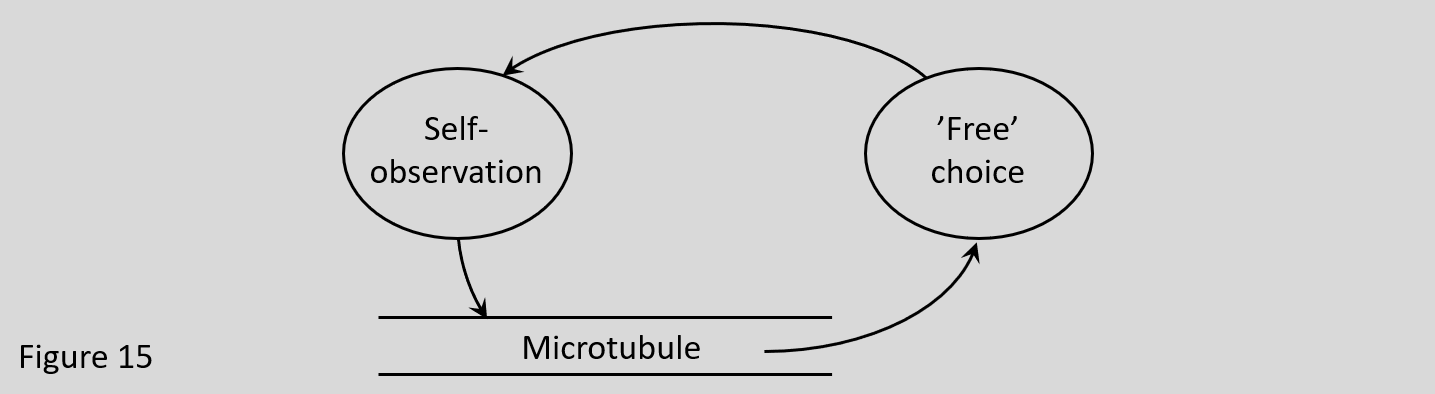
Another reason may be that most physicists and many philosophers of science dislike the strict epistemic perspective I adopt, where the structure of knowledge and the structure of the world reflect each other. The subjective and objective aspects of the world are seen as distinct but inseparable, neither being more fundamental than the other. Rather, the subjective and the objective can be described as emerging from each other in a self-consistent loop. Some are appalled or even scared by any model that rejects the notion of observer-independent particles or fields dancing about in space as being the fundamental ingredients of the world. These people seem to think that any alternative idea ends up in postmodernism, solipsism or vague mysticism. This is not the case.

Also, the method of my work is somewhat unconventional. It does not align with the standard approach of neither physicists nor philosophers. The line of thought can be summarized as follows:

1) Philosophical ideas

2) New formalism based on 1)

3) Assumptions based on 1)

3) Physics derived from 2) and 3)

Nevertheless, there are conventional aspects of my work. The philosophical ideas align with those of several fathers of quantum mechanics – like Niels Bohr, Werner Heisenberg, Wolfgang Pauli, Paul Dirac and Max Born. I just try to define these ideas more precisely and apply them more generally.

Of course, what I derive or argue for conforms to established physics. I’m not one of those oddballs who reject relativity or quantum mechanics in long self-published manuscripts. If you arrive at something that contradicts scientific results based on the work of thousands of scientists during decades or centuries, you are simply wrong – like all the politically charged climate science deniers.

I have got some positive feedback and constructive criticism that may be worth building upon. For example, a recent referee report for the paper A cognitive basis for physical time (arXiv:2411.01427) contains the following passage:

This paper contains some novel and interesting insight, but I do not think that in its present form is suitable for publication in an academic journal. I am aware that when a proposal is genuinely novel it is difficult to present it through usual vocabulary and conceptual apparatus, but the author should make an effort to lead the reader into the new territory step after step. In this very long paper, new ideas and concepts are defined and introduced at almost every page, and it is difficult to evaluate the overall picture. I suggest the author split the paper in at least two parts.

It should be added that other referee reports contain more negative opinions, such as the presentation in my papers being messy, incomprehensible, self-contradictory, or that the problems the work tries to solve do not exist.

Regarding the suggestion in the cited referee report that I split the paper into several parts: it touches a nerve. I mentioned that I tried to divide the first long manuscript into pieces to make the material publishable. The first paper on the subject of time that I wrote was the result of such a division. Then I divided it into two pieces once more, and then once more. If I’m going to divide it once again, it will be the fourth division.

Such a strategy of divisions raises a dilemma. To make reviewers and colleagues appreciate what I have done, it is necessary to be able to present some interesting results in each paper, in particular in the first paper ever to be published. Also, since the approach is quite novel, these results must be well motivated. That is, the papers must be self-contained. Since the research method consists of the four steps listed above, a considerable amount of material needs to be presented to reach from start to finish, from step 1 to step 4. Such a paper necessarily becomes quite long and involved.

After the rejection of the above-mentioned paper A cognitive basis for physical time, I recently posted it on the arXiv together with the companion paper Generally covariant evolution equations from a cognitive treatment of time (arXiv:2411.01427 and arXiv:2411.02885). These two papers are the result of the latest division procedure.

What will I do next? I’m going to contact some more physicists who seem to entertain similar ideas, but apart from that I’m at a loss.

What needs be done is deriving consequences from the modified evolution equations and stationary state equations I have arrived at. However, this requires quite an effort, and I was hoping that I would have some published papers and some minimum of funding as a steppingstone before I would embark on that journey. Also, with such a foundation in place, I was hoping that some other physicists with more mathematical knowledge and better analytical skills than mine would be willing to contribute to such work.

If anyone is interested, I present my work somewhat more in detail on my personal website.

On that webpage, I offer quotes from great thinkers of the past who have inspired me. The oldest one is from Democritus, according to a later fragment from Galen, in a dialogue between the intellect and the senses:

Intellect: Ostensibly there is colour, ostensibly sweetness, ostensibly bitterness, actually only atoms and the void.
Senses: Poor intellect, do you hope to defeat us while from us you borrow your evidence? Your victory is your defeat.

The only way to avoid debating for another 2 500 years whether the proper philosophical perspective is the scientific realism of the intellect, the empirical idealism of the senses, or some third alternative where intellect and senses are forever interlocked in a tight dance, is to see these competing perspectives as scientific racehorses. The philosophical approach that makes it possible to account for the most of physics in the simplest and most coherent way should be declared the winner. What I am trying to do is to put my own philosophical racehorse at the starting line of that competition, and to ride it until it either stumbles and falls, or others see that it is worth betting on.


Den gröna industrirevolutionen i Småland

2024 Posted on Sun, February 18, 2024 21:42:25

I upptakten till finanskraschen år 2008 steg oljepriset mot skyn. Min oljepanna slukade olja för 35 000 kr per år. Bergvärme var för dyrt för mig, men jag hade nätt och jämnt råd att installera en luft-vatten värmepump. Den passade väl ihop med de stora gamla värmeelementen i huset.

Jag kände mig lokalpatriotiskt stolt när jag insåg att flera företag i närheten tillverkade så bra värmepumpar: NIBE i Markaryd och CTC i Ljungby. Dessutom IVT i Tranås, lite längre norrut. Till slut valde jag CTC. Jag sparade 20 000 kr genom att välja en utsocknes rörmokare från Lund. Det är fortfarande inte förlåtet i byn.

Min värmepump fungerar fortfarande perfekt; den enda gången jag behövt tillkalla reparatör var precis före innevarande vinters första köldknäpp. En felaktig inställning gjorde att pumpen stannade ibland. Enkelt och billigt fixat.

Jag gjorde min värmepumpsinvestering under den högkonjunktur för de svenska tillverkarna som inföll under det oljeprisrally som föregick finanskraschen år 2008. Energikrisen i samband med Rysslands invasion av Ukraina har lett till ännu större efterfrågan på värmepumpar i hela Europa – och i resten av världen.

De småländska fabrikerna går på högvarv igen, och fler fabriker byggs. Hela stadsdelar anläggs i skogen utanför Markaryd, en dryg mil norr om Vittsjö där jag bor. År 2022 gick NIBE med 5,7 miljarder kr i vinst, varav 4,3 miljarder kr kunde hänföras till försäljning av värmepumpar och tillhörande utrustning.

DN skrev nyligen om NIBE:s framgångssaga, och om att konkurrensen i värmepumpsbranschen nu hårdnar. Skälet till att Småland och Sverige ännu så länge är världsledande, och därmed kunnat slå mynt av det nymornade intresset för energieffektivisering, är att vi var föregångare tack vare statliga satsningar. Jag klipper följande stycken ur en historik publicerad av Energimyndigheten år 2009:

”I Sverige tog utvecklingen av värmepumpar fart i slutet på 1970-talet. Oljekrisen 1973–74 drev fram ett kraftigt forskningsstöd för att utveckla inhemsk energi. Bland annat stöttade staten utveckling och demonstration av olika typer av stora värmepumpar för fjärrvärmenät och tester av olika tekniker för villavärmepumpar.”

”1993 ryckte statliga Nutek åt sig initiativet på värmepumpsfronten genom att utlysa teknikupphandlingstävling för att dra ur proppen ur den nästan stillastående marknaden och samtidigt styra bort från el- och oljeuppvärmning. Det skulle visa sig vara ett lyckokast.”

”16 värmepumpstillverkare inbjöds att tävla om att ta fram ny teknik som skulle spara 30 procent energi till 30 procents lägre kostnad. Pumparna skulle vara små, lätta att installera och byta ut och inte innehålla några ämnen som kunde skada ozonskiktet i atmosfären.”

Tillverkarna förmådde klara kraven och tävlingen sparkade igång marknaden på allvar. Nu finns en värmepump av något slag i 47 procent av Sveriges småhus.

När jag själv funderade på att ersätta oljepannan med en värmepump tänkte jag inte så mycket på klimatet – impulsen kom från de dyra oljeräkningarna. Ett pojkaktigt intresse för teknik spelade också in. Värmepumpar var något man läste annonser om i villatidningar, snarare än i debattartiklar av miljövänner. Präktiga och nördiga familjefäder diskuterade problem och möjligheter i internetfora och gav varandra råd – ibland med sakkunskap, ibland utan.

Nu har värmepumparna blivit politiska, åtminstone utomlands. Så här twittrade den konservative gurun Jordan Peterson i mars 2023 när en kanadensisk minister uppmuntrade invånarna att installera värmepump:

“Don’t fall for it Canadians. It’s environment-apocalypse propaganda”

När det gäller värmepumpar verkar vi svenskar ännu så länge vara immuna mot den idiotiska kampanj som vill associera förnybar energi och energieffektivisering med ”vänster”, ”woke”, ”klimatalarmism”, ”vekhet” och ”flickaktighet”. Skälet är nog att var tidigt ute. Vi är redan betingade i stället att associera värmepumpar med prudentlig gnosjöanda.

Anledningen till att kampanjen som vill bromsa omställningen till fossilfrihet är mycket mer intensiv nu än för 15 år sedan är att fossilindustrin först nu är hotad på allvar – när investeringarna i fossilfri energi sprungit förbi investeringarna i fossil energi och den förnybara elproduktionen växer närapå exponentiellt.

Att Jordan Peterson gjort sig till språkrör för den kampanj som förtalar det förnybara och hyllar det fossila kan förklaras med att han är från Alberta, en provins i Kanada med en omfattande fossilindustri. Produktionen av icke-konventionell olja i Alberta – utvunnen ur tjärsand eller genom fracking – har ökat snabbt de senaste 15 åren. Motståndet mot energieffektivisering och förnybar energi i Alberta är därmed begriplig, även om den är kortsynt. En alltför snabb omställning kan leda till ekonomiska och sociala problem.

När vi svenskar anammar samma perspektiv som Peterson och hans gelikar kastar vi däremot allt förnuft överbord. Vi luras att zombieaktigt gå någon annans ärenden och skada vårt eget näringsliv.

I Sverige utvinns ju ingen fossil energi. Däremot har vi en världsledande industri i Småland som blomstrar tack vare ökande global efterfrågan på värmepumpar. Vi har en snabbt växande näring som bygger vindkraftverk och anlägger solcellsparker. Förutsättningarna för fortsatt expansion av denna industri är goda tack vare att vårt land är stort och glesbefolkat, och har en lång kust med bra vindförhållanden.

Vi har dessutom goda förutsättningar att producera mer hållbara biodrivmedel än idag. Detta till trots har Sunpine i Piteå tvingats dra ned produktionen av förnybar talloljediesel med 30 procent, som en följd av att reduktionsplikten sänktes drastiskt vid årsskiftet. Enligt branschföreningen Svebio fryser nu planerade investeringar i svensk produktion av biodrivmedel värda cirka 20 miljarder kr inne.

Sveriges satsning på värmepumpar inleddes som sagt på 70-talet som en reaktion på oljekrisen. Den blev startskottet till att bryta beroendet av fossil eldningsolja i industrin och för uppvärmning. Det lyckades tack vare satsningar på fossilfri el, bioenergi och energieffektivisering. Som diagrammet nedan visar var omställningen snabb och genomgripande.

Nu genomlider vi en ny energikris kopplad till fossil energi. Den har lett till periodvis skyhöga priser, liksom på 70-talet. Det grundläggande skälet till krisen är Rysslands aggressioner. Den enda försäkringen mot framtida kriser är att helt släppa taget om den fossila rodeohästen och odla vår egen trädgård, bli självförsörjande på fossilfri energi.

Därför är det så knäppt att regeringen nu väljer motsatt väg och med berått mod ökar fossilberoendet, i synnerhet i transportsektorn. Det är något nytt. Inga tidigare regeringar skulle komma på tanken att göra något liknande i nuvarande situation, oavsett färg.

Den enda förklaring jag kan se till att det görs nu är den effektiva kampanjen att associera det energieffektiva och förnybara med begrepp och företeelser som är negativt laddade för konservativa. Denna kampanj har en logisk utgångspunkt i fossila amerikanska och ryska intressen.

Som vi sa på skolgården: gå inte på den lätte.


“He’s not so easily stopped uttering his prophecies”

2023 Posted on Wed, March 22, 2023 08:56:42

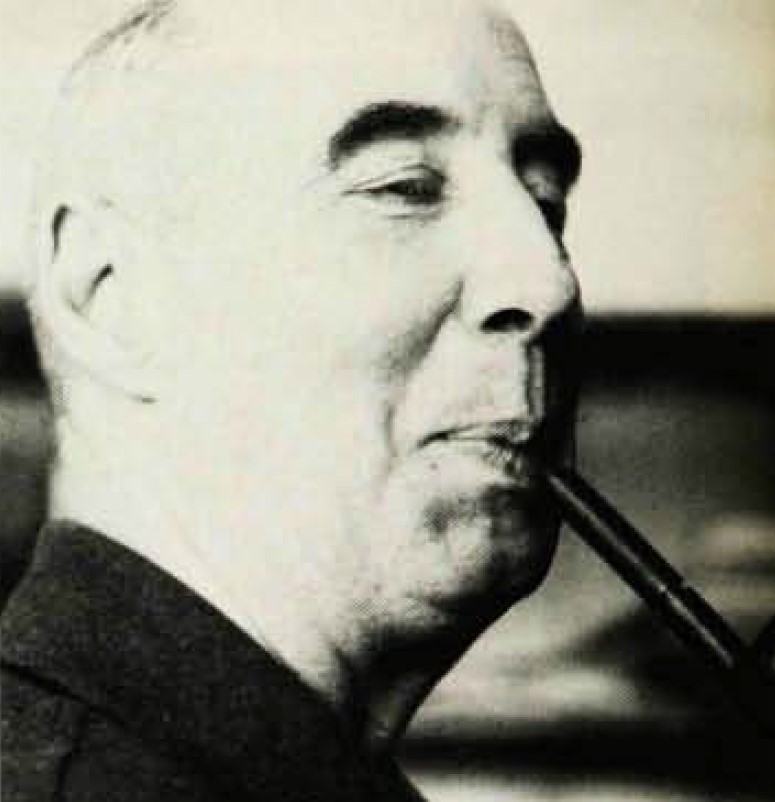
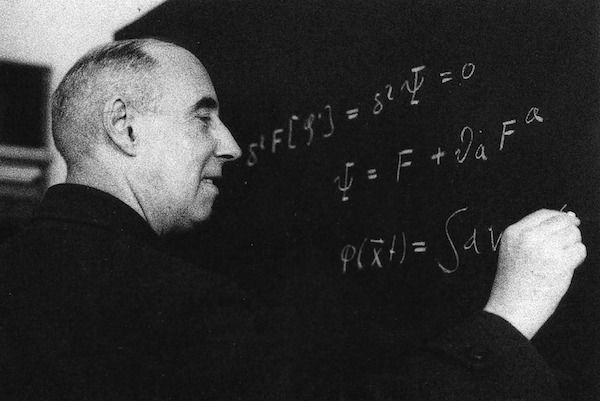
Ernst Stueckelberg came up with many of the most fundamental ideas in 20th century theoretical physics but got little recognition. I learned about him when I realised that an evolution equation I derived from philosophical musings was introduced by him already in 1941. Stueckelberg was a modest man who struggled with life.

Ernst Stueckelberg was born in Basel in 1905. His mother Alice belonged to an aristocratic German family. That explains his impressive but cumbersome full name: Johann Melchior Ernst Karl Gerlach Stückelberg von Breidenbach zu Breidenstein und Melsbach.

When Alice’s father died, Ernst inherited the title Baron Souverain of the Holy Roman Empire of the Teutonic Nations of Breidenbach at Breidenstein and Melsbach. Ernst’s father Alfred was a lawyer, and his family had been citizens of the canton of Basel since the 14th century. Alfred gave his son a strict upbringing, seemingly to live up to his noble maternal heritage.

After obtaining his Ph.D. in physics in Basel at the young age of 22, Ernst was offered to come to Princeton as a research associate. There he applied the recently invented quantum mechanics to analyse the properties of molecules. The American physicist Philip Morse recollects [1]:

I also came to know a rather stiff young man, tall and thin, with an aristocratic profile and a Prussian manner and carriage. […] We came to be close friends, perhaps because opposites attract. [… He] could not help his name, nor could he help his mannerisms, which had been drilled into him by his father. He once told me his father would not allow him to take off his coat or tie even when he was studying by himself in his own room.

One of Stueckelberg’s achievements at Princeton was to explain the continuous spectrum of the hydrogen molecule H2. Later in life he expressed pride that this feat got it into the New York Times.

Available accounts differ on the order of events, but it seems that the Depression forced Princeton to let Stueckelberg go [2]. Back in Switzerland he could only get a job as a poorly paid Privatdozent.

Ernst married in 1931. Not long afterwards he seems to have lost a considerable wealth that belonged to his wife in naïve investments. To earn their living, Stueckelberg was forced to enlist in the army.

The pressing circumstances may have contributed to the fact that Stueckelberg began to express symptoms of mental illness around this time. These problems would haunt him for the rest of his life. His condition has been described as manic-depressive psychosis. He was often balanced and brilliant, but from time to time he had to retreat to the asylum for a few weeks.

The financial situation improved in spring 1935, when Stueckelberg was promoted to professor at the University of Geneva. When he returned to Europe, he had abandoned molecular physics and started working in the quickly developing fields of quantum theory and elementary particle physics.

Nevertheless, he was quite isolated, partly because of his personal situation. This is illustrated by the fact that between 1935 and 1943 Stueckelberg published 42 papers, 40 of which as the sole author.

He didn’t travel much and published most of his work in the local journal Helvetica Physica Acta, which was not widely read in the international physics community, partly because the articles were written in French.

His main lifeline to the scientific world was his friend Wolfgang Pauli, who, on the other hand, was central to the world of theoretical physics in the early to middle 20th century.

During fits of depression, Stueckelberg repeatedly submitted resignation letters to his university. They were always ignored, except once. In 1950 he had to be reinstated as professeur honoraire.

Despite his hardships, Stueckelberg came up with several groundbreaking ideas and results [3]. Some of them went unnoticed until they were rediscovered by others several years later. At least three of these ideas led to Nobel prizes – but not to Stueckelberg. Here are some examples of his achievements:

  • In 1934, Stueckelberg devised a relativistically invariant perturbation method for quantum fields that preserves the gauge invariance of the full equations. It was mostly ignored. In retrospect, these general properties would have made his scheme suitable as a starting point to understand the divergences that plague perturbation expansions in quantum field theory.

  • In 1935, he developed a model where nuclear forces were mediated by exchange particles (bosons), in a similar way as electromagnetic forces are mediated by photons. Stueckelberg dropped the idea since Pauli thought it was ridiculous. The idea was rediscovered by Yukawa, who got the Nobel prize for this work in 1949.

  • In 1938 Stueckelberg discovered a special case of the Higgs mechanism that provides mass to the nuclear exchange particles he postulated in 1935. The corresponding Higgs particle was discovered in the LHC accelerator at CERN in 2013. Peter Higgs and François Englert received the Nobel prize the same year for their theoretical prediction of the particle.

  • In 1941, he proposed the law of conservation of baryon number. Very simply speaking it says that matter can be transformed, but it cannot appear or disappear – just like energy.

  • In 1941, Stueckelberg proposed that antiparticles may be seen as particles travelling backwards in time, an idea later utilised and popularised by Feynman. In doing so, Stueckelberg introduced a novel evolution equation that separates two aspects of time. This equation is the reason I learned about Stueckelberg (see postscript).

  • In 1943, he outlined the idea of renormalisation to come to terms with the divergences to infinity that plague quantum field theory. Stueckelbergs’s paper was rejected by Physical Review as too sketchy. Later, Schwinger and Feynman published their version of the idea, which was more detailed and contributed to their Nobel prize in 1965.

  • Stueckelberg’s work on renormalisation was formalised in 1953 together with the mathematician Andrée Petermann, with whom Stueckelberg discovered the renormalisation group. It expresses in general terms the effects of a scale change on the description of a physical system. Kenneth Wilson was awarded the Nobel prize in 1982 for his work in this field, which has wide-ranging applications, including phase transitions and critical phenomena in thermodynamics.

  • Heisenberg came up with the idea of the scattering matrix (S-matrix) to represent the probabilities that initial sets of particles transform into other sets of particles. He hoped that the S-matrix could be used as a fundamental description of the microscopic world, thus getting rid of the mathematical problems associated with interacting quantum fields. Stueckelberg and Feynman independently published useful perturbation recipes based on the S-matrix programme in 1949. The two approaches are basically equivalent. Feynman illustrated his method by means of the famous Feynman diagrams of particle reactions.

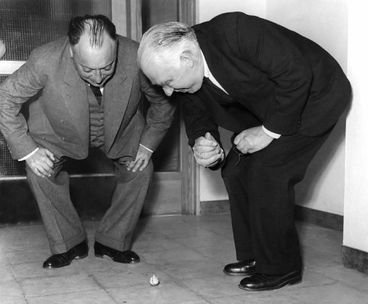
A few weeks after receiving the Nobel prize in 1965, Feynman gave a lecture at CERN outside Geneva. Stueckelberg attended. Afterwards, Stueckelberg was making his way out alone from the amphitheatre. Feynman, surrounded by admirers, made the remark [4]:

“He did the work and walks alone toward the sunset; and, here I am, covered in all the glory, which rightfully should be his!”

Research and teaching seem to have been the focus of Stueckelberg’s life – perhaps like clear, calm lakes in the messy and troubled landscape of life. He didn’t seek recognition and seemed uninterested in administration, or in building a research group around his own ideas.

According to colleagues and students, Stueckelberg had a peculiar and careful style of writing and teaching. He is known for the generality and depth of his ideas, but also for idiosyncratic notation and convoluted expression. Therefore, his work was sometimes hard to understand and appreciate – even for highly gifted colleagues like Pauli.

Wolfgang Pauli was a harsh critic of the work of other physicists, Stueckelberg included. According the their colleague Konrad Bleuler: “[F]or Pauli, a lecture hall was a kind of a holy place where only truth was allowed. And a wrong statement was a sacrilege.” Bleuler recalls [5]:

“Stueckelberg always knew really special — I might say prophetic — ideas. He gave a lecture and of course Pauli — it happened very often — didn’t agree. And said ‘you are not allowed to say such things.’ But you see, Stueckelberg being a prophet, he’s not so easily stopped uttering his prophecies. So Pauli in despair menaced Stueckelberg with a stick and it seemed — I was not present myself but I was told — that the seminar ended like the war of Troy, Pauli, rather corpulent, with his stick after Stueckelberg around the table in the lecture hall.”

Stueckelberg’s health deteriorated in the 1960s. Electroshocks and experimental medication for his mental illness slurred his speech and sometimes affected his thinking. Crippled by arthritis, he was carried to seminars in the arms of younger colleagues [2].

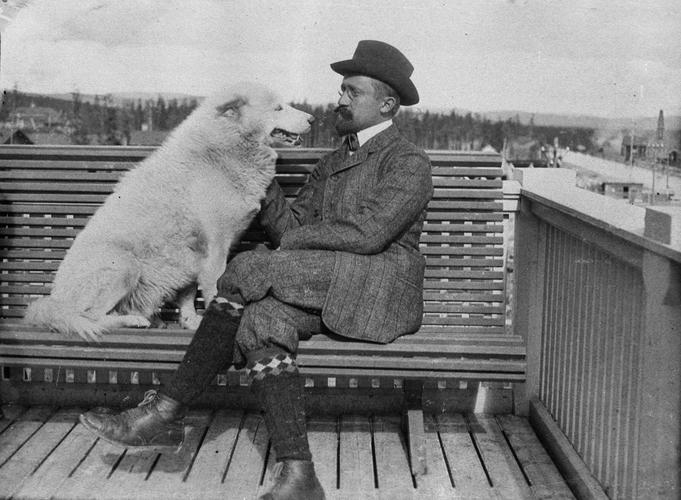
He brought his dog Carlo III to his lectures and often talked to the animal about the subject at hand. Some claimed that the dog seemed to understand tensor calculus, since it barked when Stueckelberg made an error at the blackboard. The sceptic part of the audience suspected that the dog rather reacted to the hesitation of his master when he was about to commit a mistake.

In the final part of his life Stueckelberg embraced the Roman Catholic Church. He turned away from quantum theory and elementary particles to study relativistic thermodynamics. That subject may have had existential significance to Stueckelberg as it relates to the arrow of time. He devoted an entire book to it. According to fellow Swiss physicist Charles Enz [6]:

“[H]is book on thermodynamics makes arduous reading, defying the traditions of pedagogy, language, and notation. It is a logical construct without compromise, a cathedral of the spirit erected to prove with the aid of the notion of entropy that the time of physics is indeed the ‘biblical time’ having a beginning and an end, and not the ‘Greek time’ that flows uniformly from an infinitely distant past to an infinitely distant future.”

Stueckelberg had to end an interview a few months before his death because he was tired [2]. He painfully lifted himself out of his chair with two canes. A heavy gold cross dangled from his thin neck. “I look forward every day to my eventual journey to Heaven”, he said. “We live too long.”

Postscript

Here I describe how I came into contact with Stueckelberg and his work. In so doing I sketch some of my own ideas relating to time.

I pursue the idea that it should be possible to reconstruct the structure of physical law from epistemic principles. To this end, it is assumed that the structure of knowledge and the structure of the world reflect each other. A thorough analysis of what can be know about the world and what cannot provides lessons about the world itself.

According to this idea, one-to-one correspondence should appear between fundamental forms of appearances and the degrees of freedom in proper physical models. Here, the term forms of appearances is understood in the Kantian sense as categories of perception that are given a priori, into which all sensory impressions and all other elements of consciousness are placed.

Time is such a form of appearance. Kant viewed time as an essential such form, stating that it is a necessary representation that grounds all intuitions.

We can actually separate two aspects of the temporal form of appearance. The most basic one is the perceived flow of time, the directed sequence of events. This aspect of time may be parametrized by the variable T. On top of that we can measure temporal distances between events. Such distances may be expressed by means of the variable t. At each point in time T, which we may call now, we have knowledge of temporal distances t between an entire set of events, stretching from the present arbitrarily far back into the past. Of course, we may also know about the spatial distances between these events. Therefore, an entire space-time

$(x,y,z,t)$

can be associated to each T, representing the known spatio-temporal relations at the present point in time. From the assumed epistemic perspective, the variables T and t should be treated as independent degrees of freedom in our physical models, even though they are related. From more careful considerations of this kind, it is possible to derive a quantum mechanical evolution equation

$i\hbar\frac{\partial}{\partial T}\Psi(x,y,z,t,T)=R \Psi(x,y,z,t,T)$

where R is some Hermitean operator. This equation corresponds to the Schrödinger equation with a second temporal variable. The temporal metric is contained in t, meaning that relativistic transformations apply to t, but not to T. This makes the above evolution equation relativistically invariant, in contrast to the Schrödinger equation.

A few years ago I learned that Stueckelberg had arrived at the same equation already in 1941. He did not start out with philosophical musings like I did, but with his well-known desire for symmetry and relativistic invariance.

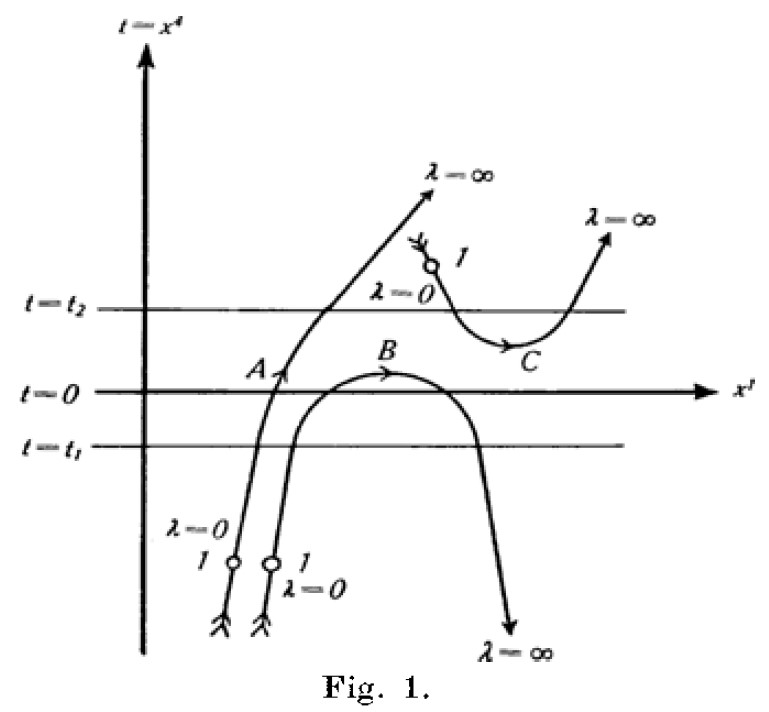
Stueckelberg used the evolution parameter T to be able to create particle trajectories that bended backwards in time t. He interpreted such trajectories as the creation or the annihilation of a particle-antiparticle pair, according to the figure below (taken from Ref. [7]).

The weakness of Stueckelberg’s approach is that he never provided any physical motivation for the introduction of the evolution parameter (which he called λ).

From the subjective point of view, it is very natural to unfold the now, represented by a given value of T, into an entire temporal axis t. Suppose that you listen to music. The appreciation of harmonies, and the emotional response they give rise to in the present, depend crucially on memories of sounds in the immediate past, and their metric intervals, to the extent that the music would cease to exist without these memories. That is, each present state of the listener contains both the present and the past in a crucial way.

At the formal level of physical description, the very perception of a sound at a given moment T relies on sensory recording during an extended period of time t, since such a temporal interval is needed to determine the frequencies that define the sound that we hear at a given moment. The same goes for spatial perceptions, since they arise when light with different frequencies enter the eye.

References

[1] Philip M. Morse, In at the Beginnings: A Physicist’s Life (MIT Press, 1977)

[2] Robert P. Crease and Charles C. Mann, The Second Creation, pp. 140-144 (Macmillan, 1986)

[3] Jan Lacki, Henri Ruegg, and Gérard Wanders (eds.) E. C. G. Stueckelberg, An Unconventional Figure of Twentieth Century Physics (Birkhäuser, 2009)

[4] Jagdish Mehra, The Beat of a Different Drum: The Life and Science of Richard Feynman, pp. 573-577 (Oxford University Press, 1994)

[5] Lillian Hoddeson, Interview with Konrad Bleuler, January 20, 1984 (Transcript by American Institute of Physics)

[6] Charles P. Enz, Ernst Stueckelberg, obituary, Physics Today 39(3), pp. 119-121 (1986)

[7] Ernst Stueckelberg, Remarque à propos de la création de paires de particules en théorie de relativité, Helvetica Physica Acta 14, pp. 588-594 (1941)


En sympatisk svensk industripionjär i Norge

2022 Posted on Sun, December 04, 2022 13:24:21
Albert Petersson och Leonie Witt, vid en bestigning av Gaustadtoppen som nyförlovade. Foto från kraftmuseet.no

I somras besökte jag vattenkraftverket i Tyssedal och den närbelägna lilla staden Odda, längst in i Sörfjorden. En för mig okänd svensk visade sig vara en omtyckt centralgestalt i ortens historia.   

I februari 1906 seglade ingenjör Albert Petersson in i Sörfjorden och insåg att Odda var den perfekta platsen att anlägga en karbidfabrik. Orten hade direktkontakt sjövägen till exportmarknaderna via isfria fjordar, och bara sex kilometer därifrån vid Tyssedal forsade höga vattenfall. De kunde ge kraft till den energikrävande tillverkningen.

Albert Petersson föddes i Landskrona år 1870. Selma Lagerlöf var hans guvernant, vilket kan förklara hans senare litteraturintresse. År 1895 blev han doktor i kemi vid ETH i Zürich, endast 25 år gammal.

Karbid ett ljus i mörkret

Tre år tidigare hade kalciumkarbid upptäckts. Ämnet kunde bland annat användas i karbidlampor och för att skapa svetslågor. Som nybakad doktor reste Petersson till Geneve och etablerade de första industriella försöksanläggningarna. År 1896 återvände han till Sverige och blev direktör för Alby karbidfabrik.

För egen del har jag en kort men intensiv relation till karbidlampan. Vid ett besök i silvergruvan i Potosi i Bolivia blev vi utrustade med karbidlampor när vi tog oss ned i de smala, vindlande gruvgångarna, som saknade elektriskt ljus. Arbetarkooperativ bedrev malmbrytningen med primitiva medel efter det att gruvföretaget lagt ned verksamheten på grund av dålig lönsamhet. När någon sprängde med dynamit i en närbelägen gruvgång blåste tryckvågen ut ljusen och allt blev svart. Vår guide blev inte det minsta nervös och tände lamporna igen. Men karbiden etsade sig fast i mitt minne.

Stolta planer blir verklighet

År 1906 stod det klart att kapaciteten i Alby karbidfabrik var otillräcklig och att mer elkraft behövdes. Petersson var en av grundarna till företaget AS Tyssefaldene. De skrev under ett kontrakt där de lovade att bygga ett vattenkraftverk i Tyssedal som inom två år skulle ge 20 000 hästkrafter el till den karbidfabrik i Odda som de engelska ägarna till fabriken i Alby samtidigt skulle uppföra.

Albert Petersson bosatte sig i Odda och gifte sig med Leonie Witt, dotter till den tyske kemiprofessorn Otto Witt. År 1907 fick de sonen Klaus.

Löftet att på kort tid leverera 20 000 hk infriades, med hjälp av kapital från Wallenberg. Kraftledningen löper än idag längs den branta bergssidan från Tyssedal till fabriken i Odda, där karbidtillverkningen kom i gång redan år 1908. Regleringen av vattenfallen ovanför Tyssedal fortsatte. Stenhuggarmästare från Bohuslän ledde bygget av en 520 meter lång kraftverksdamm.

Kraftverket i Tyssedal var det första storskaliga vattenkraftverket i Norge. Det gav ström inte bara till karbidfabriken, utan även till andra energislukande industrier som smältverk och konstgödselfabriker – och till hela samhället. På orten menar de att detta var startskottet till hela Norges industrialisering.

Vattenkraftverket Tysso I i Tyssedal. Foto Lars Mæhlum

Den gröna industrirevolutionen

Även i Sverige ordnade energislukande industrier sin egen kraftförsörjning under industrialiseringen vid förra sekelskiftet. Jag har länge tänkt att de skulle kunna göra det på nytt, för att ro den ”gröna” industrirevolutionen i hamn – som ju förväntas sluka enorma mängder el.

Jag har hört Svenska kraftnät beklaga sig över risken att vi annars fastnar i ett Moment 22: de vågar bara investera i ny nätkapacitet om de vet att den kommer till användning, och industrin vågar bara investera i nya fabriker om den vet att de får tillgång till kraft. Dilemmat gäller även själva kraftproduktionen. Om det ska det byggas stora vindkraftsparker till havs och nya kärnkraftverk måste det ju finnas avsättning för all el som produceras.

Nyligen läste jag att H2 Green Steel funderar på att råda bot på situationen genom att själva bygga vindkraft i Norrbotten, nära det planerade stålverket utanför Boden. Wallenberg har gått in med kapital i H2 Green Steel, liksom de gjorde för drygt hundra år sedan i AS Tyssefaldene. Andan från förra sekelskiftet kanske återupplivas!

Jättar och gudar

Fram till mitten av 1800-talet var Sörfjorden en avkrok. Enstaka bondgårdar och stugor klamrade sig fast vid bergsväggarna. Den dramatiska naturen sågs som grotesk och frånstötande, enligt guiden på kraftverksmuséet. Sedan började engelska turister besöka området. Naturromantiken spirade.

Industrialiseringen tog död på turismen. Ännu idag löper en djup skiljelinje mellan dem som bejakar exploateringen och dem som drömmer sig tillbaka till ett oförstört naturtillstånd. Lokalbefolkningen är delad på mitten.

Men turisterna har kommit tillbaka. Trolltunga har blivit världsberömd. Den smala klippformationen sträcker sig ut över Ringedalsvatnet, som stenhuggarna från Bohuslän dämde upp.

Motsättningen mellan den miljöförstörande industrin och den ursprungliga naturen med dess väsen är grundackordet i Netflix-serien Ragnarök. Där ges den mytologisk laddning som en kamp mellan jättar och gudar och kläs i en superhjältehistoria. Serien utspelar sig i Edda, en lätt omskrivning av Odda.

Guiden på kraftverksmuséet muttrade över att inspelningsteamet blandat ihop industrierna i Tyssedal och Odda när de skulle gestalta det industrikonglomerat som ägs av jättarna.

Ett varmhjärtat direktörspar

Albert Petersson och Leonie Witt var inga ondsinta jättar, utan var mycket omtyckta i Odda. De isolerade sig inte i sin direktörsvilla, utan umgicks med alla, oavsett klasstillhörighet. När någon blev sjuk i ett fattigt hem gick Leonie dit med delade ut mat och blommor. Om Albert skrev direktörskollegan F.W. Bruce:

Under alt sit arbeide samlet dr. Petersson om sig og utdannet en stor stab av medarbeidere, og hans karakter og føreregenskaper gjorde at alle var ham hengivne. Alle søkte at gjøre sit bedste under ham og en anerkjendelse fra hans mund blev sat pris på, da den kom fra en mand som kjendte sit arbeid. Han interesserte sig også levende for sine arbeidere og önsket at de skulde leve under de bedst muligt vilkår. Han var altid meget interessert i bygning av arbeiderboliger, og når nogen var i vanskeligheter vidste han altid hvem han skulde henvende sig til.

Alberts lånade ut pengar ur egen ficka till bygget av Folkets Hus i Odda, och han hjälpte arbetarrörelsen även på andra sätt.

Arbetare vid bygget av den stora kraftverksdammen år 1914. Foto från tyssefaldene.no

Död och sorg

Lyckan för paret blev kortvarig. Leonie dog i barnsäng år 1910 när Ingrid, deras andra barn, skulle födas. Albert drog sig undan sällskapslivet till sitt arbetsrum i direktörsvillan. I ett brev till sin syster Signe i Sverige skrev han:

Nu kan det vara nog med tekniska och affärsaker. Men det är ju det enda jag upplefver och det som binder mitt intresse.

Leonie bar smeknamnet Maus. Albert fortsatte:

Förr tog Maus mitt hela interesse och det tekniska och affärerna varo mina bisaker.

Utbrottet av första världskriget skapade osäkerhet på marknaden och förvärrade en likviditetskris hos karbidfabriken. Det fanns inte pengar att betala el eller löner. Tre veckor senare, kvällen den 18 augusti 1914, steg Albert ombord på en båt som skulle ta honom till Bergen. Därifrån skulle han segla vidare till London för att träffa ägare och investerare.

När båten ankom till Bergen morgonen därpå fanns inte Albert Petersson kvar ombord. I sjöförklaringen nämns ett plask mitt i natten. Kaptenen hade stannat båten för att söka efter man överbord utan resultat. I polisrapporten beskrivs händelsen som en drunkningsolycka utan vittnen.

Fabriken lever vidare

Karbidproduktionen var viktig för krigsindustrin. Fabriken överlevde likviditetskrisen och gick med vinst under krigsåren. År 1921 gick den däremot i konkurs, vilket gjorde tusen anställda arbetslösa. Tillverkningen återupptogs 1924 och fortsatte till 2003, då minskad efterfrågan på karbid och högre elpriser ledde till att fabriken lades ned för gott.

Fabriksområdet är nu öppet för allmänheten och håller på att omvandlas till ett industrimuseum. Ännu så länge är det hela rätt provisoriskt.

Postuma hyllningar

År 1916 restes ett minnesmärke över Albert Petersson i Odda i form av en bautasten. Då skrev arbetarrörelsens tidning Odda Tidene dessa minnesord:

Det falder sjelden eller aldrig i et arbeiderorgans lod desværre at kunne skrive så uforbeholdne ord om en arbeidsleder som vi kan gjøre i dette tilfælde. Doktoren hadde selv skaps sig et godt mindesmerke – det vakreste som kan tænkes – ved sit liv. Det er enkelte som kanske vil si: han delte av sin overflod. Men hvor mange gjör nu egentlig det? Og om nogle gjör det, så er det måten at gi på som setter sit stempel på mennesket, at det ikke betragtes som en almisse, men nærmest som en vennehånds rækning.

Albert Petersson med en av sina hundar i Alby, före flytten till Norge. Foto från kraftmuseet.no


To tango with the world

2022 Posted on Thu, July 07, 2022 19:16:47
Image: Dansmuseet/Tobias Regell

It takes two to tango. We are interlocked in a dance with the world we see around us until death. If the universe is deterministic, the observed world leads the dance and the observing being follows. But, according to modern physics, each dancer can surprise the other with unexpected moves, taking the couple to parts of the dance floor that cannot be predicted.

If each dancer can surprise the other, and force a response, they are both indispensable to understand the ways of the world. Then the role of the subjective or the objective aspect of the world cannot be accounted for in terms of the other. The observer and the observed becomes equally fundamental.

This has been the take in my attempts to reconstruct physical law from underlying philosophical principles. I see the subjective and objective aspects of the world as two sides of a coin that can be distinguished but not meaningfully separated.

For example, to imagine an objective world that dances alone without any subjective partner in sight is a contradiction in terms, since the very word ‘imagine’ presupposes a subjective dance partner watching what goes on from the side lines.  

I have come to realise that this perspective resembles that of the renowned theoretical physicist John Archibald Wheeler in his later years. He coined the term participatory universe and came to believe that the relation between the observer and the observed is a crucial element in the world. Each one of us helps bring a collective world into being by our observations.

In a sense, this is the middle ground between a solipsistic idealism where the world is dreamed by a single subject, and metaphysical realism, where an objective world independent of any observers is all there is.

John Archibald Wheeler

Wheeler came to this view thinking about the conundrums of quantum mechanics. According to the original Copenhagen interpretation of the theory, it is meaningless to ask what moves the world makes on the floor when his observing dance partner loosens the grip and looks away.

This is so since all potential moves by the world in the time window before the observer grabs her partner again and fixes her gaze must be taken into account collectively in order to calculate correctly the probabilities what she will actually see at that point in time. The potential moves interfere with each other, and they all acquire a kind of quasi-reality.

Wheeler brought matters to a head by introducing the so-called delayed-choice experiment, devised in 1977. [1] In the tango metaphor it involves observing the tracks on the floor of the objective world, deducing its past moves. If the subjective dancer chooses to observe the tracks in a proper way, she can indeed deduce the past choreography.

But she can also choose to erase some tracks with a piece of clothing. And here comes the odd thing. To correctly calculate the pattern she will see on the floor after the sweeping of the cloth we again must take into account all potential tracks of the past.

Clearly, the subjective dancer has erased information about the past moves of the world. This is quite normal. A thief can hide her tracks. But not only that, she has denied the world any definite choreography at all at the passed point in time when it presumably should have been displayed. Further, by her choice of actions she can choose now whether to grant her dance partner any definite past choreography or not. This is quite a power.

Apparently, the history of the universe depends on how it is observed today. The obscure parts of the past seem to have no definitive reality until it is, perhaps, brought to light at some later time. If true, this highlights the essential role of the observer in the construction of the universe in the entire space-time domain.

Wheeler invented his own version of the game twenty questions to illustrate the state of affairs. Normally, a group of people agree upon a word, and another person asks yes-or-no questions to each one in the group. The interrogator wins if she converges on the agreed upon word before she has asked twenty questions.

In Wheeler’s version, each person in the group chooses her own word without telling the others. As the interrogator asks a question to one of the members and gets an answer, the others in the group may have to change their individually chosen words to be consistent with that answer. In the end, the word that the game converges on might not be any of the words chosen beforehand.

The word is clearly created in the interactive process of asking questions and selecting consistent answers, just like the moves of the objective world in the tango are not definite until his subjective partner checks them out. I let Wheeler describe the game and its interpretation in his own vivid words at the bottom of this blog post. The excerpt is taken from his essay Frontiers of Time. [2]

In Wheeler’s game, the group of people selecting words corresponds to the outside world, and the interrogator to the subject who poses questions about it, getting answers by observation or experiment. Both the word-selecting group and the interrogator have their freedom to make choices, and all these choices determine where the game ends up, at what final word.

In the same way, both dancers in the tango of the world can surprise their partner with their moves, taking the couple to unexpected parts of the dance floor.

Speaking less poetically and more physically, the observing subject has the freedom to choose what experiment to make, and the world has the freedom to select an outcome to that experiment, with probabilities given by the quantum mechanical formalism, as applied to the chosen experiment.

Both of these two kinds of choices change the state of the world and leads it into a new direction that could not have been predicted before the choices were made. And, according to present understanding of physics, the choice by the subject of the experiment to be made cannot be reduced to a probabilistic outcome of a meta-experiment, as discussed in another blog post.

Our tango with the world indeed seems to be an interactive improvisation. Sometimes the subjective observer leads, and maybe more often the objective observed world does. It feels like most of the time we must follow its merciless moves, dictated by the laws of physics. But sometimes the world has to follow us. Then it must produce an improvised response consistent with the same laws of physics.

To allow for the multitude of observers, we may see the world as a movie set, and ourselves as actors, rather than as a dancing couple. Here is a charming story about the mutual improvisations in the setting and among the actors that led to The Godfather – which in hindsight seems like an inevitable classic.

The following is an excerpt from the essay Frontiers of Time by John Wheeler

The universe can’t be Laplacean. It may be higgledy-piggledy. But have hope. Surely someday we will see the necessity of the quantum in its construction. Would you like a little story along this line?

Of course! About what?

About the game of twenty questions. You recall how it goes – one of the after-dinner party sent out of the living room, the others agreeing on a word, the one fated to be questioner returning and starting his questions. “Is it a living object?” “No.” “Is it here on earth?” “Yes.” So the questions go from respondent to respondent around the room until at length the word emerges: victory if in twenty tries or less; otherwise, defeat.

Then comes the moment when we are fourth to be sent from the room. We are locked out unbelievably long. On finally being readmitted, we find a smile on everyone’s face, sign of a joke or a plot. We innocently start our questions. At first the answers come quickly. Then each question begins to take longer in the answering – strange, when the answer itself is only a simple “yes” or “no.” At length, feeling hot on the trail, we ask, “Is the word ‘cloud’?” “Yes,” comes the reply, and everyone bursts out laughing. When we were out of the room, they explain, they had agreed not to agree in advance on any word at all. Each one around the circle could respond “yes” or “no” as he pleased to whatever question we put to him. But however he replied he had to have a word in mind compatible with his own reply – and with all the replies that went before. No wonder some of those decisions between “yes” and “no” proved so hard!

And the point of your story?

Compare the game in its two versions with physics in its two formulations, classical and quantum. First, we thought the word already existed “out there” as physics once thought that the position and momentum of the electron existed “out there,” independent of any act of observation. Second, in actuality the information about the word was brought into being step by step through the questions we raised, as the information about the electron is brought into being, step by step, by the experiments that the observer chooses to make. Third, if we had chosen to ask different questions we would have ended up with a different word – as the experimenter would have ended up with a different story for the doings of the electron if he had measured different quantities or the same quantities in a different order. Fourth, whatever power we had in bringing the particular word “cloud” into being was partial only. A major part of the selection – unknowing selection – lay in the “yes” or “no” replies of the colleagues around the room. Similarly, the experimenter has some substantial influence on what will happen to the electron by the choice of experiments he will do on it; but he knows there is much impredictability about what any given one of his measurements will disclose. Fifth, there was a “rule of the game” that required of every participant that his choice of yes or no should be compatible with some word. Similarly, there is a consistency about the observations made in physics. One person must be able to tell another in plain language what he finds and the second person must be able to verify the observation.

Go on!

That is difficult! Interesting though our comparison is between the world of physics and the world of the game, there is an important point of difference. The game has few participants and terminates after a few steps. In contrast, the making of observations is a continuing process. Moreover, it is extraordinarily difficult to state sharply and clearly where the community of observer-participants begins and where it ends.

This comparison between the world of quantum observations and the game of twenty questions misses much, but it makes the vital central point. In the real world of quantum physics, no elementary phenomenon is a phenomenon until it is an observed phenomenon. In the surprise version of the game no word is a word until that word is promoted to reality by the choice of questions asked and answers given. “Cloud” sitting there waiting to be found as we entered the room? Pure delusion! Momentum, px = 1,4 × 10⁻¹⁹ gcm/s, or position, x = 0,31 × 10⁻⁸ cm, of the electron waiting to be found as we start to probe the atom? Pure fantasy!

Mann may be going too far when he suggests [3] that “. . .we are actually bringing about what seems to be happening to us.” However, it is undeniable that each of us, as observer, is also one of the participants in bringing “reality” into being.

References

[1] John Archibald Wheeler, The “Past” and the “Delayed-Choice” Double-Slit Experiment. In: Mathematical Foundations of Quantum Theory, pp. 9–48, Ed. A. R. Marlow (Academic Press, 1978)

[2] John Archibald Wheeler, Frontiers of Time. In: Problems in the Foundations of Physics, pp. 395-497, Ed. G. Toraldo Di Francia (Elsevier, Amsterdam, 1979)

[3] Thomas Mann, Freud, Goethe, Wagner (New York, 1937), p. 20; translated by H. T. Lowe-Porter from Freud und die Zukunft (Vienna, 1936); the cited words were included in the lecture given at the 80th birthday celebration for Sigmund Freud, 8 May 1936.


No mathematics without mathematicians, no physics without physicists

2021 Posted on Sun, January 17, 2021 04:50:00

Everything has to be based on observation, provided observation is understood correctly. Observation includes grasp of essence, which is simply left out of what is called experience most of the time – in particular, by the empiricists.

Kurt Gödel [1]

This blog post was originally submitted to the FQXi Essay Contest 2020.

Introduction

This essay points to hidden premises in the arguments demonstrating the existence of mathematical propositions that are formally unprovable. It is argued that blindness to such premises has confused the interpretation of unprovability and uncomputability theorems. The same blindness has led many to assign improper and too prominent roles to codes and computation, roles they cannot play regardless these theorems.

Similarly, there are hidden premises in the rules we use to extract predictions from quantum theory. The source of the hidden premises is the same in the mathematical and the physical cases: we have to assume outside agents who act on the system being studied – be it a formalisation of arithmetic, or an experimental setup designed to test Bell’s inequalities.

The relation between the agent and the system has a specific form. Everything with specific form can be used as a handle to new insights. In this case the claimed common source allows us to find common traits of formal unprovability in mathematics and physical indeterminism.

To find these common traits, we need to open our eyes. We are blind to the nature of the relation between ourselves and the world since we are born with it, and thus take for granted – just like we are deaf to the harmony of the spheres since we always hear it, or so it is said.

In the beginning was time

There are some premises of reasoning we cannot do away with, but which we often ignore. One such premise is the existence of time. Ignorance of this premise sometimes leads to contradictions in terms. There are physicists who deny the fundamental nature of the directed flow of time. We may imagine one of them saying: “Yesterday I realised that there is no need for time in physics, today I’m writing my result up, and tomorrow I’ll explain it at a seminar.”

Time is a premise even in logic. The prefix in the very word premise is temporal in itself (which is also the prefix of prefix). The premise comes before the conclusion. And the steps in our reasoning leading to the conclusion are like the ticking of a clock. We cannot shuffle the axioms used in a mathematical proof with the intermediate lines and the theorem, without destroying the logic. The order and direction of the elements in the proof are fundamental.

Computer games

I see a similar blindness to the premises of the reasoning when I hear some people discuss coding, and the idea that the laws of nature are like a computer program – so that life becomes a simulation. The very concept of a code requires two things external to the code itself: the structure or message that is coded, and a key or dictionary that translates message to code and back. If we use the word object in a very general sense, we may say that as soon as we talk about codes, we presuppose the three objects in Figure 1. We also presuppose a set of relations between them. The key must be placed conceptually between the message and the code.

As a first observation, it becomes self-contradictory to try to describe the universe as a code, since then we presuppose the existence of objects outside the universe, which there cannot be, by definition.

This argument can be made more concrete. If we are materialists, we must assume that the code, the key and the message are imprinted in physical objects. A computer code is imprinted in computer hardware, and the key is ultimately imprinted in the brain of the programmer. The structure that is coded may be, for example, the atmosphere. Then the code corresponds to a climate model, and we are performing a climate simulation. If we analogously claim to be able to simulate the entire universe, and entertain the idea that the universe is equivalent to such a simulation, we clearly presuppose physical objects outside the universe, making the idea incoherent.

No object is an island

Let us turn to the relations between the three objects code, key, and message. They are also presupposed as soon as you speak about codes. These relations often lack direction, since the roles of the code and the message can sometimes be interchanged. They may, for example, correspond to two different languages. The key is then a dictionary. Such relations are implicitly presupposed whenever we speak about a set of objects. In fact, the very concept of a set implies a directed relation from the set to its elements, expressing the hierarchic relation between the object that corresponds to the set to the objects that correspond to its elements.

When we encode mathematical structures such as sets in a computer program, we sometimes forget that we also encode the relations between the elements in this structure. Look at matrices, for example. We encode the magnitude of the numerical elements, of course, but also their relations via the indices that specify the position of the elements in the matrix. The rows and columns are overlapping sets of elements. In the above figure, object C may correspond to column 1 of a 2 x 2-matrix, and objects A and B to elements e_12 and e_22, respectively.

It and bit

A computer code can be seen as a string of symbols that translates to a sequence of bits fed into the computer. Such a code is completely flat, lacking any hierarchical structure, and there are no inherent distinctions between objects and relations in the code itself. Therefore we might get the following idea: since we can encode and store in a computer memory a structure such as a matrix as a string of bits, hierarchies and relations among objects are not fundamental.

However, these hierarchies and relations are not grinded into nothing in the coding process – they just move to the key. They have to be there in order to regain the structure of the matrix when it is retrieved from the computer memory. And since the key is indispensable whenever we speak about codes, relations and hierarchies defend their fundamental role in any meaningful representation of reality.

This conclusion is reinforced by the simple observation above that the existence of a code implies a key and a message, with certain relations between them. These relations are shown in Figure 1, and constitute meta-relations as compared to the relations within the encoded message. It is tempting to try to grind all these relations and meta-relations to a structureless heap by creating a meta-code that translates the entire setup of code, key and message – and all the relations within this triad – to a string of bits. But it’s easy to see that we just end up in infinite regress: the meta-code inevitably gives rise to a meta-key and a meta-message, introducing new interesting relations. To me, these simple considerations show the incoherence of the idea it from bit, and its younger sibling it from qubit.

Again, let’s be a little bit more concrete. Currently, informational approaches to quantum mechanics are popular, where information is understood in its binary form. It is true that the simplest quantum mechanical systems have two possible states, and therefore may be called qubits. But it does not follow that all other quantum mechanical systems can described as collections of qubits. Indeed, this is not the case, since there are other fundamental quantum mechanical systems which have more than two possible states, such as quarks with their three possible colour charges.

Of course we may try to encode these more complex systems as a collection of qubits, but then we inevitably presuppose something external to the heap of qubits, as discussed above. And then the model is incomplete. In this case we need a key telling us which sets of qubits describe a truly two-state system, and which describe systems with more than two states. In other words, the qubits need to be marked, just like the elements of an encoded matrix need to be marked with indices telling us which rows and columns they belong to. Again, we may try to encode these markings into a meta-code, but we will just chasing our own tail in the never-ending dance of infinite regress.

The conceptual tower

The scientific ideal is to be able to explain as much as possible from as little as possible. This ideal can be taken too far, however. One lesson from the above considerations is, I think, that we cannot choose a too small or too simplistic set of assumptions and building blocks if we want to construct a complete model of the world. We must take all of its fundamental structures and relations into account.

The spatio-temporal relations between physical objects can hardly be reduced to something more fundamental, even if some physicists try. I argued that attempts to get rid of temporal relations lead to self-contradiction. Equally fundamental are the set-theoretical relations between physical objects that we most often take for granted.

We gladly speak of composite objects like a set of three quarks in a nucleon, a set of nucleons in an atomic nucleus, a nucleus and electrons in an atom, a set of atoms in a molecule, and so forth. Yet it is a profound state of affairs that perceived physical objects can always be arranged in this hierarchical, set-theoretical manner, a fact that makes the reductionist scientific method possible. These relations between physical objects define a proto-space of relative spatial scales. Kurt Gödel referred to set-theoretical relations as quasi-spatial [1].

The perceptions of temporal relations and the perception of some physical objects being parts of others are as fundamental to our perception of reality as the perception of the objects themselves. We may call them forms of perception (or forms of appearances, like Kant did [2]). To make more refined interpretations of what we see, to understand it and to build scientific models that account for it, we need still more advanced concepts, such as algebra and analysis. Therefore, there is a sense in which the entire tower of conceptual tools at our disposal has an equally fundamental position in our scientific worldview as the physical objects.

Kurt Gödel embraced this kind of conceptual realism. He claimed that we perceive concepts directly in a similar way as we perceive physical objects. He arrived at this Platonism at the age of nineteen, and said that it led him to his groundbreaking work in mathematical logic in his twenties. Naturally, he vehemently opposed the logical positivists of his day, who claimed that simple facts verified by empirical observation were a sufficient basis for philosophy and science.

Evidently, I agree with Gödel in this respect. We cannot derive simple concepts from facts, or all higher concepts from the lower ones. If we try to do it, we will have to use the concepts we try to derive, making the arguments circular. No conceptual bootstrapping is possible. If we just try to encode the concepts, we end up in infinite regress just like before.

Think again about the idea it from bit. It is indeed an idea. The idea that the world can be described as a binary code is very abstract, yet simple and indivisible. It cannot itself be decomposed in binary form. Then this idea does not belong to the world. Then what kind of world are we talking about?

Some self-reflection is needed

If we accept the fundamental nature of all elements in the tower of abstraction, all the way up from simple observations, then what kind of reality does this tower represent? Clearly, it cannot correspond to a naive materialistic world-view, in which the only things granted fundamental significance are physical objects or fields distributed in space and time, and where everything else can be explained in terms of these.

We need to find a common denominator for all levels in the tower, just like the common denominator for all physical objects is that they are located in the same three-dimensional space.  To me, the only conceivable common denominator is that all levels in the tower are perceived or appreciated by someone; they are all integrated in the mind of an observer. In other words, all building blocks of the conceptual tower are located in the same mental space. This makes perceiving subjects equally fundamental as perceived objects. The relation between the observer and the observed becomes one of the fundamental relations of the world. This relation may be represented as follows.

When you think about this figure, it’s a bit paradoxical. In order to emphasize that subjects are equally fundamental as objects, we represent the subject as an object related to another object. You, the reading subject, look at this picture from the outside, and thus escapes the representation. We might try to represent this predicament like in the figure below.

However, you still look at this meta-representation from the outside. Clearly, whenever you want to catch the subject in order to incorporate it in an objective description, it always flies higher, escaping the butterfly net. If we repeatedly try to catch the subject in the objectification net we just end up in a similar kind of infinite regress as we already discussed in relation to messages and codes. The relation between subject and object also escapes this objectification net, emphasizing the fundamental nature of this relation. These reflections are examples of self-reference. The subject looks at itself from the outside as an object of study, and reflects on its own nature, and its relation to the objects it perceives. In such a case we may divide the single bi-directional relation between subject and object in Figure 4 into two directed relations that form a loop. We may read the upper relation as: The subject looks at an object, and the lower relation as: This object represents the subject.

In a more concrete setting, the representation of the subject may simply be our mirror image. Generally speaking, self-reference does not require a self in the sense of a personal subject, but just two or more objects with directed relations that form a loop. We may take acoustic feedback as an example, where the two objects that are related in a loop are the microphone and the loudspeaker. We need at least two objects in such a loop of self-reference; a single object referring to itself makes no sense, I think. We need the mirror image to see ourselves; I cannot see my face directly with my own eyes.

Semantic self-references may seem genuinely self-referring, but this is not really so. Consider the famous liar paradox: This statement is false. This sentence is actually the set of two parts that carry meaning: a subject and a predicate, where the predicate refers to the subject.

A: This statement (subject)

B: is false (predicate)

C: This statement is false (sentence)

The first part A does not refer to itself, but to C. Referring to Figure 2 we may draw the following figure. Here we have two loops: one with two objects A and C, and another one with three objects A, C and B.

With the liar paradox we approach Gödel’s famous first theorem about the incompleteness of axiomatic arithmetic.

Looking at a theorem

Let me try to illuminate the structure of Gödel’s proof in the light of the discussion so far. Much more detailed – but still generally accessible – accounts can be found in several places, for example in the charming little book What is mathematical logic? [3]

The basic idea is just to modify the Liar paradox in the following way.

A: This statement (subject)

B: cannot be proved (predicate)

C: This statement cannot be proved (sentence)

This statement is self-referential in the same way as the Liar paradox, as expressed in Figure 8. Clearly, it must be true to avoid contradiction. Thus we have a true statement that cannot be proved, and thus truth goes beyond proof.

This is just cheap semantics, of course. To make a precise mathematical theorem out of it, we first have to replace the word statement with formula. Further, we must refer to a specific formula, which we may call F. Since the word statement defines part A above, but also refers to the entire sentence C, the entire claim This statement cannot be proved must itself correspond to formula F. To create such a correspondence we must find means to code sentences such as C as formulas of the same type as F. We may then write

A: Formula F

B: cannot be proved

C: This statement can be coded as a formula F, which cannot be proved.

The above formulation makes the hierarchical, set-theoretical difference between A and C explicit: whereas A is a formula, C is a statement about a formula (which in turn can be coded as a formula).

The formulas and proofs we are talking about here belong to the realm of formal systems. Below is shown an alphabet of 13 symbols that is sufficient to express any arithmetic proposition as a string of these symbols called a formula. For example, the number two is expressed as s(s(0)),where the symbol s can be interpreted as the successor of. The number two is clearly the successor of the successor of zero.

To a formal system also belongs a set of axioms and a set of allowed inferences. The axioms are just a set of formulas, and the inferences are mechanical rules that allow us the get new formulas from an old one. A proof of a formula F becomes a sequence of formulas, where the first one is an axiom, and the last one is F.

To code a statement about formulas and the possibility to prove them into a formula, as required in sentence C, Gödel introduced a method to code formulas and proofs as integers, now called Gödel numbers. One way to do it is shown above. It uses the uniqueness of the decomposition of an integer into a product of primes.

The coding makes it possible to say whether a given integer is the Gödel number of a formula, or a proof, or neither. If it is the Gödel number of a formula, the formula can be decoded, and if it is the Gödel number of a proof, the proof can be decoded.

With the help of the coding schemes expressed in Figures 9 and 10 we can close the semantic loop in Figure 8 in a mathematically well-defined sense.

We have to find a formula F that closes this loop and makes it self-consistent. Such a formula is not too hard to formulate [4]. As a consequence we get Gödel’s first incompleteness theorem: In any consistent formal system with an interpretation that contains arithmetic, there is a formula F that cannot be proved or disproved within the system. Since the arithmetic interpretation of any formula is either true or false, it follows that in any formalisation of arithmetic, there is a true proposition that cannot be formally proved. Here truth is defined within element D in Figure 11, whereas provability is defined within element C.

A common but controversial inference is that human reasoning is something else than the mechanical procedures of formal proofs and the execution of computer programs. We seem to have access to more truth than a computer can ever have, and therefore we must stand outside and above the mechanics.

What I want the reader of this essay to take to heart is the following: we make use of the last statement in order to prove Gödel’s theorem. It is a presupposition. The inference is therefore a tautology. (Gödel’s theorem itself is certainly not.)

If we want the proof of Gödel’s theorem to stay within the formal system it analyses, the formula F must speak about itself. But there is no genuine self-reference in the sense of Figure 7. Instead, to make the argument in the proof go through, we presuppose three elements in a loop, where the formal system under study is just one of them. We also use the hierarchical nature of set theory according to Figure 2. Such hierarchies are non-existent within a formal system.

Hey you

Elements C and D in the loop in Figure 12 correspond to propositions and statements. They carry meaning, which must be defined subjectively. What we presuppose in the proof of Gödel’s theorem is therefore an agent who observes the formal system from the outside. We presuppose ourselves, naturally.

In this picture, the arrows pointing to and from A in Figure 12 correspond to a relation between the observer and the observed. In his proof, Gödel demonstrates that this relation is fundamental in order to understand mathematics, and the limitations of its formalisation.
There is an analogous situation in physics. It was realised in the beginning of the twentieth century that there is a limitation to classical, Newtonian physics: it cannot account for all observed phenomena. Quantum theory was therefore invented. A decisive difference between classical physics and quantum theory is that the latter treats the relation between the observer and the observed as fundamental. This is so since we find a rule among its postulates that tells us which values of a quantity can actually be observed in a given situation, and also a rule that gives us the probability to observe each of the allowed values.

Many physicists want to explain away this fact, trying to derive these postulates from the others. What they want to do, in effect, is to objectify the act of observation. They argue that as far as physics concerns, it is sufficient to consider ‘observations’ made by a measuring apparatus. Such an ‘observation’ just amounts to an interaction between the system of interest and the apparatus. I have argued in relation to Figure 5 that it is logically impossible to erase the subject in this way; we just end up in infinite regress. The messiness and incompleteness of the mathematical frameworks that come out of these attempts suggest that it is a dead end in physics as well.

Self-dissection

At the same time, the truly materialistic approach to the physical world has proven immensely fruitful in the past. And neuroscientists have unravelled close neural correlates to our subjective mental states. How do these facts go together with all of the above?

We may try to make all these things fit together by introducing an operational version of materialism, in which each shift in our subjective perception corresponds to a shift in the brain state. The odd thing in our predicament is that the brain state is a state we observe according to the laws of quantum theory, just like all the other things around us. The brain state is therefore itself a subjective perception, in a sense. We get a self-referential loop in physics similar to the one in mathematics that Gödel pointed out.

We have to pause for a minute, though. If operational materialism is interpreted very strictly, it should be possible to explain each of our actions as a result of the processes going on in the brain. There are two potential problems with this picture – one mathematical and one physical.

Let us start with the mathematical problem. In this picture, the brain should be seen as analogous to a computer. But then it could also be seen as analogous to a formal system, mechanically processing input like axioms, producing output like true formulas. However, we have argued that the structure of Gödel’s proof presupposes something fundamental that is external to the formal system itself, yet interrelated to it. There is no place for such subjective externalities in this strict version of operational materialism.

The physical problem has to do with causality. Quantum theory is expressed in the following form: Given that we observe a certain system in a certain way, the probability to see this or that is so and so. If I look to my right I will see this or that with certain probabilities, and if I look to my left I will see this or that with other probabilities. But the theory does not say anything at all about which direction I will actually look. This is often called Heisenberg’s choice, and it lies outside the scientific description, as far as quantum theory can tell. There are not even any probabilities associated with it.

Heisenberg’s choice is fundamental within the theory and has tangible consequences; it affects the future evolution of the physical world. Yet it is impossible to account for it in a picture where all choices reflect the actions of a brain whose state evolves according to the laws of physics. This is true even if those laws are probabilistic, like in quantum theory. (We may, of course, try to express Heisenberg’s choice as the outcome of a probabilistic quantum experiment, but we just run into the arms of our old friend infinite regress.)

To make the idea of operational materialism consistent with known mathematics and physics we clearly have to find its limitations. Again, there is one mathematical and one physical side of the coin.

Mathematically, or rather logically, we may construct a self-referential loop where a subject observes her own brain state F as she is about to make a choice. The choice may then be such that it contradicts the state F supposed to give rise to it. The set-up is similar to the circuit shown in Figure 11 in order to motivate Gödel’s theorem.

In this case the conclusion would be that there are brain states F such that a choice is made by the owner of the brain that cannot be accounted for by F.

We may try to find the physical source of the limitation to operational materialism in the architecture of the brain. We should clearly search for a microscopic structure that is crucial for information processing, having the potential to influence macroscopic action. It must further be able to hide its inner state from outside scrutiny, at the same time as this inner state may influence the information processing being performed by the structure.

The so called microtubules are intriguing candidates. These extremely thin tubes are abundant inside neurons. Their circular circumference is composed of just thirteen tubulin molecules, whereas their length can stretch to the centimetre scale. The tubulin molecule has a discrete set of possible conformations. Conformational changes can spread like waves along the tube, suggesting that the surface of the microtubule acts as a cellular automaton, performing computations relevant to brain function.

The interior of the microtubule is filled with water. One may speculate that the state of this water is unknowable to a large extent. This may be so because the rigid lattice formed by the tubulin molecules only allows a discrete number of collective states of the entire microtubule surface, whereas the possible states of the water inside the tube is probably much higher. If this is the case, some information about the inside of the microtubule is necessarily lost at the surface.

In this way we may be able to avoid the possibility to gain perfect knowledge of our own brain state. Such a limitation would make the idea of operational materialism consistent with the limitations of computability and determinism highlighted by Gödel’s theorem and quantum theory, respectively. It would also make operational materialism conform with the fundamental role given in this connection to the observer and her relation to the observed world. I come to think of a quote by Niels Bohr:

The idea suggests itself that the minimal freedom we must allow the organism will be just large enough to permit it, so to say, to hide its ultimate secrets from us. [5]

Stuart Hameroff and Roger Penrose have argued forcefully for the idea that microtubules play a crucial role for the appearance of consciousness. [6] Their perspective is somewhat different from the one I present here, however. Several recent studies [7] point to the important role of microtubules for the higher brain functions, even though the underlying mechanisms are still unknown.

The conceptual clock tower universe

The world view promoted in this essay incorporates the observing subject in a never-ending dance with the observed world. The couple is forever interconnected by a fundamental relation. It also incorporates fundamental forms of perception such as time and set-theoretical hierarchies into which the naked sense impressions are placed, and also some more abstract concepts used to interpret and relate them. It is claimed that such a world view is often implicitly presupposed even by those who explicitly deny it.

Sense impressions, forms of perception, and higher concepts are seen as equally fundamental in this world view, and define different floors of a conceptual tower. It is suggested that the world is this tower, with all its inhabitants and furniture. Then the outline of the tower, together with the stairs that run between the floors, the pipes and ventilation shafts, must correspond to the laws of physics, as well as to the structure of the mathematics used to express these laws. If this is true, forms of perceptions and the structure of mathematical concepts should give clues to the laws of physics, and vice versa.

Since the perception of physical objects in three-dimensional space is just one of the floors in the tower, the tower itself is not built in this concrete, ordinary space, but is located in a more abstract space, which cannot be separated from awareness.

The objectivity of such a world does not reside in the physical objects that are observed in three-dimensional space. Rather, it resides in the parts of the conceptual tower and how they fit together. The tower has its rotating cogwheels, like a mental mill, or a clock. True, this is another kind of clockwork universe than that suggested in the seventeenth century. Even so, it is not for us to decide how the conceptual clock tower operates in its abstract space, what the pieces look like and how they fit together. That cannot be changed by our wishes. We can still get crushed between its cogwheels. In that sense such a universe is still objective.

References and notes

[1] Hao Wang, A logical journey: From philosophy to Gödel, The MIT Press (1996).

[2] Immanuel Kant, Critique of pure reason, translated by P. Guyer, and A. W. Wood, Cambridge University Press (1998).

[3] John N. Crossley et al., What is mathematical logic? Oxford University Press (1972).

[4] Since element C in this loop is a statement about a formula whose nature can be varied, we should consider corresponding formulas F’(x) with a free variable x. We may then specify F as follows, as an arithmetic proposition within element D in the loop: There is no y such that y is the Gödel number of the proof of formula F with Gödel number z, where F is defined as F’(x) with x replaced by z, as expressed symbolically in the formal alphabet.

[5] Niels Bohr, Light and life, Nature 131, 421-23 (1933).

[6] Stuart Hameroff, and Roger Penrose, Consciousness in the universe: a review of the ‘Orch OR’ theory, Physics of Life Reviews 11, 39-78 (2014). [7] Travis J. A. Craddock et al., Anesthetic Alterations of Collective Terahertz Oscillations in Tubulin Correlate with Clinical Potency: Implications for Anesthetic Action and Post-Operative Cognitive Dysfunction, Scientific Reports 7, 9877 (2017); María del Rocío Cantero et al., Bundles of Brain Microtubules Generate Electrical Oscillations, Scientific Reports 8, 11899 (2018).


The fear of the black tide of mud

2020 Posted on Sun, January 26, 2020 14:29:31

This is an English translation of a blog post in Swedish published in 2017.

A summer day in the mid 70s I was sitting in my parent’s Volvo PV outside a public swimming pool in our home town Lund, Sweden, listening to the radio. My big sister attended swimming school. The voice on the radio talked about a space probe which had investigated Jupiter and its moons. In hindsight I conclude it must have been Pioneer 11. The existence of alien planets and the infinite space struck me with wonder and fear.

Much later I have pondered the strange fact that our familiar landscape with towns, fields and forests floats on top of bottomless seas of glowing magma. But this thought has not led to the same feeling of striking wonder as the thought of the planets in space did when I was three or four years old. It has not grown to much more than a thought.

To some extent it certainly has to do with age. Most of us become less receptive to immediate impressions as we grow up. We spin a cocoon around us weaved of thoughts about the world. On the inside of this cocoon we paint pictures of the outside. As time goes by we paint layer on top of layer of conceptions. They make it harder and harder to see and perceive the world – what we see are just our own conceptions of it.

It is the same thing with memories. Throughout my life I have been thinking about the radio broadcast about alien planets that made such an impression on me. That makes it hard to know if I really remember the event by now, or if I just reach my previous attempts to remember it, the pictures of the event I have painted as I lost access to the proper memory.  

The ever thicker layers of paintings on the inside of the cocoon make it almost opaque. It becomes hard to feel the wind of the world through the threads out of which it is spun. Of course, that makes it harder and harder to paint accurate pictures of the world. Finally we just reproduce the pictures we have already painted, since that is the only thing we see. Even though we may the best of intentions, our world view deviates more and more from the world as it really is.

It seems to me that much of the follies in the world, and much of its misery, has its root in the fact that people ceases to see the world, ceases to see themselves, seeing only their own conceptions, hearing only their own statements about it. People who are blindly convinced of the goodness of the ideology they have painted in front of themselves and each other, can step on and crush innocent people without noticing it, feeling like walking on air, with a blessed smile on their face.

The blind conviction that you belong to the good side is most often associated with religion, but is sometimes ascribed to the political left. But the right suffers from a blindness of its own. People on the right can become so convinced that their own perspective is the only rational one that they do not see that other perspectives can be equally reasonable. They do not see that they, with reason as a beacon, go astray in ideological quagmires and sink into the irrational swamp.

If the political right sometimes confuses ideology with reason, materialists sometimes confuse their own world view with science. But science is just a method to gain knowledge. Whether science supports a materialistic world view can only be decided empirically. The answer is not given beforehand.

From the days of Newton until the previous turn of the century science provided ever more support to such a materialistic or realistic world view. The objects that we look at are really out there, regardless whether we observe them or not. The observer is secondary, and is equivalent to the intricately cemented piece of matter that constitutes its body.

But since the beginning of the 20th century science have started to point in another direction. The theories of relativity and quantum mechanics demand an observer to make it possible to motivate and understand its equations in a simple way. To express it more vividly: the living subject seems to be a fundamental part of the world.

I cannot help following the debate on these matters among physicists and philosophers of science. Even though science no longer provides support to a naively materialistic world view, many physicists and philosophers refuse to accept that this is so. They feel so comfortable with the pictures they have painted on the inside of their cocoons – pictures of objects that dance about independent from themselves – that they hold their ears if you knock on the outside of the cocoon and tell them that the world out there seems to be organized in a different way.

At this point someone will surely object that I contradict myself when I talk about a world outside the cocoon when I have just said that science suggests there are no objects independent from the living subject. But I use the term the world out there in a somewhat more subtle sense. For instance, the absence of objectively existing stuff does not preclude the existence of objectively existing laws of nature which govern what we see. We may be right or wrong when we interpret the world and its behaviour. To borrow the motto from The X-Files: The truth is out there.

My impression is that physicists who persist in their narrow materialistic world view rarely responds to, in a sober and pertinent way, those empirical facts and theoretical models that point in another direction. They do not even want to consider that they are wrong, or play for a minute with alternative world views to see where they lead. Instead, these are discarded with contempt, silence or with far-fetched theories with the sole purpose to uphold the preconceived world view despite all the facts that speak against it.

As an example of such a far-fetched theory I want to mention superdeterminisim. This idea has surfaced in order to explain away the strange behaviour of pairs of particles which are quantum mechanically entangled. Let me make a detour to explain what this means, and the return to superdeterminism, which has been called the final conspiracy theory.

That two particles are entangled may mean that if we examine one of the particles and find it in a certain state, the probability to see the other particle in a similar state immediately increases, regardless how far away it is located – be it in another galaxy. In a certain sense, this probability increase travels infinitely fast from one of the entangled particles to the other. Einstein called this phenomenon spooky action at a distance. The increased probability that the other particle will be found in a similar state as the first one means that the states of the two entangled particles becomes strongly correlated when we examine both of them.

There is not necessarily anything mystical or strange about such behaviour. We may imagine that the two particles have definite states to begin with, before we observe them, and that the probabilities we use to describe these states just reflects our ignorance about their actual states. In that case we may say that there are hidden variables whose values determine the state of each particle. Such a model is deterministic and the probabilities play no fundamental role. Therefore there is no need for a probability transfer from one particle to the other with infinite speed. The state we observe in one of the particles is already determined by the hidden variables. The increased probability to observe a similar state in the other particle is due to our increased knowledge about the values of the hidden variables as we observe the first particle, which, logically, affects the probability to observe a similar state in the second particle. But the fact of the matter is that this state is determined in advance, even if we do not know until we observe it.

A more detailed statistical analysis reveals, however, that such a deterministic explanation with hidden variables cannot give rise to such strong correlations between the entangles particles as seen in experiment. (This is true, at least, in all normal models with hidden variables, where these describe properties of the particles themselves, and go along with them as they move.) On the other hand, the experimental results agree perfectly with the predictions of quantum mechanics.

But in quantum mechanics there is no determinism; the state of the entangled particles are not given before we observe them, and the probabilities are fundamental quantities. We have returned to a model where an observation of one of the entangled particles immediately changes the state of the other, in terms of changed probabilities.  

Ever more refined experiments rule out almost all other explanations of these phenomena than the quantum mechanical one. One of few remaining possibilities to avoid quantum mechanics and Einstein’s spooky action at a distance is to imagine that it is determined beforehand which observations of the entangled particles we are going to make. Then it may be determined that we are always going to do observations that seemingly confirm the strong correlation predicted by quantum mechanics, even though the correlation would have been weaker if we were able to choose our mode of observation freely.

But how on earth could something like that be determined beforehand, and when would it be determined? A research group in Vienna has recently challenged this idea by letting random colour variations in the light from a star located 600 light years away determine the way in which one of the particles in the entangled pair was observed, while colour variations in the light from another star located 2 000 light years away in the opposite direction determined the way in which the other particle was observed. The idea behind this arrangement was to push back the point in time at which the mode of observation has to be determined as far as possible. Since the light from the nearest of the two stars was emitted 600 years ago it must have been determined during the middle ages how the experiment in Vienna in 2016 would be carried out. An absurd thought.

Now we come back to superdeterminism. Rather than to imagine it was determined in an obscure way during a secret counsel below medieval vaults how scientists in Vienna would observe pairs of entangled particles in 2016, we may transcend to a general law of nature that we must always do observations that seemingly confirms quantum mechanics. In reality, though, the world is deterministic and can be described by a mathematical model with hidden variables. This would become clear if only the scientists could choose freely which experiments they are going to perform. Mother Nature is conspiring against us. She consistently hides her true face by just showing us carefully chosen glimpses, which we collect to a distorted portrait.

The truth is that very few physicists take superdeterminism seriously. But among those who do we find the Nobel laureate Gerard’t Hooft and some other highly talented people. How is it possible? I can only understand it psychologically. The metaphysical world view they have painted at the inside of  their cocoons means so much to them emotionally that they refuse to accept that the world out there looks different when they look through the peep-hole in the wall of the cocoon drilled by science.

Aided by that metaphor we may express the idea of superdeterminism as follows. The physicist who is prisoner in her own world view does not want to believe what she sees when she looks at the world through a hole in the wall of the cocoon. She therefore gets the brilliant idea that what she sees, what seemingly contradicts her world view, is just a small picture that someone out there holds in front of the peep-hole. If this someone moved away this little picture so that the physicist inside her cocoon could look out freely, the world would look exactly like she imagined to begin with. But it never happens.

It is easy to make fun of other people’s follies. But each one of us carries a world view that gives meaning and direction to our lives, to our striving. If somebody tries to take it away we react instinctively and forcefully since we risk losing our foothold. We all know the firm grip of religious or political convictions, the impossibility to make someone change her mind by argumentation and finding examples contradicting this conviction. As long as possible we tweak our argumentation and reinterpret empirical facts to defend our position. Those who know me might say that I defend my standpoints more vigorously than most other people, whatever objections I face.

What is interesting is that this forceful and irrational (or rather a-rational) reaction is as evident in scientific battles as in religious or political ones. Evidently, the progression of science since the days of Newton has inspired a metaphysical materialism among Westerners that we adhere to and refuse to let go regardless what science itself suggests. We have become dependent on Newtonian materialism; to question it is to touch something very sensitive in our inner self.

I am psychologising. That is another habit of mine, apart from defending my positions stubbornly. Maybe it is because my dad was a psychologist. Freud, Adler and Skinner were often present at the dinner table when I was a kid, and they looked down on me from the book shelves.

As I grew up, I pulled the books from the shelves and started to read, Freud made a strange impression on me. He wrote with exquisite clarity, control and apparent logic, but the reasoning sometimes led to conclusions that seemed far-fetched or just nuts. I never managed to bridge the gap I sensed between the secure, authoritative voice that you like to listen to, and the fixated querulant who pursues strange theses in absurdum. Conspiracy theorists have a similar trait; they put forward facts and circumstances that support their theories in a seemingly waterproof way, and you are easily caught in the web they spin, but if you take a step back all of it appears far-fetched and stupid.

It is the same thing with superdeterminism. Those physicists who take this final conspiracy theory seriously must suffer from some kind of fixation; they must carry something they feel that they cannot afford letting go, someting that leads these highly intelligent people deep into the irrational quagmire with science and rationality as a beacon.

In his autobiographical book Memories, Dreams, Reflections Carl Gustav Jung devotes an interesting chapter to Freud and their interrupted friendship. Jung relates a conversation that he had in his youth with Freud, where the latter expresses a serious urging:

”My dear Jung, promise me never to abandon the sexual theory. That is the most essential thing of all. You see, we must make a dogma of it, an unshakable bulwark” He said that to me with great emotion, in the tone of a father saying, “And promise me this one thong, my dear son: that you will go to church every Sunday.” In some astonishment I asked him, “A bulwark – against what?” To which he replied, “Against the black tide of mud” – and here he hesitated for a moment, then added – “of occultism.”

I cannot help associating Freud’s conviction of his own sexual theory to some physicists’ conviction of the materialistic world view. Jung analyses Freud’s fixation to his own theory, and I would like to apply a similar analysis to these physicists:

One thing was clear: Freud, who had always made much of his irreligiosity, had now constructed a dogma; or rather, in the place of a jealous God whom he had lost, he had substituted another compelling image, that of sexuality. It was no less insistent, exacting, domineering, threatening, and morally ambivalent than the original one. […] The advantage of this transformation for Freud was, apparently, that he was able to regard the new numinous principle as scientifically irreproachable and free from all religious taint. At bottom, however, the numinosity, that is, the psychological qualities of the two rationally incommensurable opposites – Yahweh and sexuality – remained the same.

We just have to exhange the word sexuality for materialism. The latter should rather be described as amoral than morally ambivalent, though. But both are equally exacting. The former explains the entire human psyche, according to Freud, and the latter explains the entire world, according to its adherents.

But why would we, Westerners, like to exhange God for Materialism? Sexuality is an attraction of its own, apart from being scientifically irreproachable. But what is the allure of materialism? A possible explanation is that it is soothing. It teaches us that life is just some molecules that happen to gather into a human body for a short period of time, that love is just chemistry, that happiness is just a cocktail of neurotransmitters in the brain. The recurrent word just turns into a lullaby that makes us relax. We do not have to wrestle like Jacob with God, we cannot chose freely between good and bad, we have no responsibility for our choices before God or eternity. To question materialism becomes, in that light, an attempt to try to snatch a quilt from somebody’s bed, a quilt that makes life lukewarm and comfortable.  

The world can be described as materialists say that it is, but it is not just like that, even though this description is a very effective tool to manipulate the world as we know it. The closer we examine matter itself, the more it dissolves before our eyes to mathematical abstractions that cannot be interpreted materialistically. The behaviour of the entangled pair of particles is an example of this fact.

Another explanation why belief in materialism stays strong despite these insights is its limitation; its keyword just spares us from infinity. When you think about it, there is hardly any other myth about the world that is easier to understand, and at the same time gives us the feeling that we understand everything. We get the feeling that we are done with the world. It allows us to lock ourselves into a small cocoon where we feel safe, at the same time as it creates the illusion to behold the entire cosmos thanks to the easily comprehensible world view that is painted on its inner walls.

I started this reflection by telling how infinity and the unknown outer space made me tremble as a little kid. A similar trembling and dread can be seen in the laboratory dogs in the Youtube film below, when their cages are opened and the see for the first time ever a large lawn in front of them, and the sky above. A came across this film a long time ago on Facebook, among all the touching and funny animal films that circulate there. But this film stayed in my memory. It is not only touching, but also existential. Just look how the dog watches the outside world with fear and wonder one minute and thirty seconds into the film, and look how the dogs hardly dare to touch the strange grass with their paws to begin with.

The advantages I see to stay in the cage of materialism are, as noted above, that it is soothing and that infinity is shielded. But there are serious drawbacks as well. First and foremost it becomes necessary to deny yourself and your fellow human beings. The living subject has no place in such a world view. Sure, some people say that consciousness can be explained as a collective result of the many intricate processes going on in certain complex systems, like the human brain. According to this line of thought, consciousness is emergent. But that is an empty word in this connection, even though it sounds beautiful. A five year old who has not yet been stuck in materialistic conceptions realises that subjective perceptions and the objective items of these perceptions are qualitatively distinct aspects of the world. It is impossible to deduce the ones from the others, just like it is impossible to deduce colours from sounds or letters from figures.

It is odd that so many people turn to materialism despite the self-denial that is required. It was logical as long as science suggested a strictly materialistic world; you had to try to accept that the world is as cold and mechanistic as it seemed to be. But science no longer points in that direction. Therefore there has to be an irrational force that makes us want to deny ourselves.

Is it psychologically necessary? Don’t we have the guts to look into each other’s eyes and say ”Hey, you exist and your existence means something! You are, you are not just. You cannot be reduced to something else, you are a miracle!” Are we so frightening that we better close our eyes before the mirror? Most of us have brushed our teeth in front of the bathroom mirror and suddenly happened to look into our own eyes. Then it may happen that your self-consciousness is heightened, like in an acoustic feedback; the primitive sensation that you exist causes vertigo. Then you are pushed away from yourself again, like if somebody pulled the cord from the socket to put an end to the feedback loop.

That the living subject is a fundamental aspect of the world does not necessarily mean that there is providence, warmth, a benevolent God. Is the thought of a cold and living world more frightening than the thought of a cold and dead world? Is that the reason why we turn to the second alternative? A living monster maybe scares us more than a mechanical monster?

When I categorically claim that materialists deny the living subject, I do not claim that they are cold and ruthless towards themselves and other people. Luckily, most of them do not live as they preach. To speak psycho-language again, they are mentally dissociated. Thought, feeling and action do not fit together. This dissociation is equally grave among materialists as among Christian creationists who at the same time are interested in science, and enjoy the fruits in the form of modern technology.

As I see it, the entire Western society is dissociated in this way. Newton concluded that the same laws of nature applied in heaven and on earth. The angles had to land on the ground, cut off their wings and make their living just like anybody else. From this insight there is a line of development to the ideal of equality that was forcefully expressed in the French revolution and in the U.S. constitution. We are equal before the law and have the same rights and obligations. The society of privileges crumbled. Rulers answered to the people rather than to heaven. The individual started to be seen as the fundamental unit of society and all individuals were assigned the same value.

At the same time there is no place for the living individual in a materialistic world view inspired by Newton’s physics. The word individual derives from Latin and means indivisible, but the only unit that is indivisible in a materialistic world is the atom, which is the Greek version of the same word. Man does not possess an indivisible soul but is equivalent to his body, which can be divided into ever smaller parts until we reach the level of the atoms. The behaviour of these atoms is determined by the laws of nature, and therefore the behaviour of human beings are completely determined by the same laws of nature. There is no place for the free will that is a prerequisite for Western justice, which is based on individual responsibility. The laws of society are therefore dissociated from the laws of nature that have inspired them.

Such dissociation at the root of a society cannot be sustainable in the long run. Then the right hand of the societal body does not know what the left hand does. When one of the dissociated conceptions finally crumbles under the pressure from the other, there will be confusion and aggression because of the lack of understanding of the underlying forces that has led to this situation.

The incompatible traits of individualism and atomistic materialism are exposed most clearly in the abortion debate. When does the foetus stop being just a collection of atoms in the womb of a woman, becoming an individual of its own? When does it acquire the right to its own life? The most stubborn abortion advocates do not even seem to realise that it is an existential problem that we have to tackle in one way or the other. Instead they repeat as a mantra that the woman has the right to her own body. But that answer is an non sequitur since it does not address the question. That is the way a dissociated individual reacts, a person unable to let two aspects of her conceptions meet and chafe.

Many people who lock onto a certain type of conception and refuse to try other perspectives are probably just afraid what will happen if they let go. Seas never sailed are filled by fantasy with sea monsters. If you admit that abortion is an existentital problem you are afraid that you are immediately transformed into a fanatical pro-life acitivst in the U.S. who foams with rage, waving placards referring to the Bible outside abortion clinics. If you would admit that personal existence is unfathomable, that we cannot explain the spark of life, you are afraid that you are immediately transformed into a spaced out new age type who cannot think straight.

Wolfgang Pauli is an example showing that this does not have to be the case. He is one of my favourite physicists. When he was thirty years old he underwent a crisis. He divorced, his mother committed suicide; he started to drink, quarrelled, and had intense dreams that worried him. To get help he contacted Carl Gustav Jung, who worked in Zürich, just like Pauli. Jung is considered to be the great mystic among the psychologists, with his ideas about the collective unconscious, about archetypes and synchronicity. Pauli embraced these ideas despite his scientific outlook, and he seemed to need them to understand himself and his dreams.

What is more, Pauli had no problems whatsoever to accept the new direction away from materialism that physics took as a result of the quantum mechanics that he helped to develop himself. He even predicted that future physics would move even farther away from these conceptions. Even so, Pauli was anything but a spaced out new age type who could not think straight. He was commonly known as the conscience of physics, and ruthlessly criticised colleagues who wrote papers, which lacked exact result and predictions, or which were logically and mathematically obscure.

Sure, his exact scientific personality and his need to explore subjective states of mind reveal a double face. But at least he tried to get the two mental poles to cooperate more harmoniously, to avoid dissociation. In a letter to Jung from 1934 he describes his dreams about wasps, and interprets the separate dark and bright stripes on their bodies as symbols of the two diametrically opposed attitudes in his own psyche. In the same letter he also writes:

The specific threat to my life has been that in the second half of life I swing from one extreme to the other […]. In the first half of my life I was a cold and cynical devil to other people and a fanatical atheist and intellectual ”enlightener”. The opposite to that was, on the one hand, a tendency toward being a criminal, a thug (which could have degenerated into me becoming a murderer), and, on the other hand, becoming detached from the world – a totally unintellectual hermit with outbursts of ecstasy and visions.

One may ask whether Western society has to go through another convulsion before the two incompatible principles of individualism and materialism that it is built upon become reconciled, in the same way as Pauli started to tackle the incompatible aspects of his personality only after a personal crisis. Let us hope that it is possible to dissolve the societal dissociation in a more harmonious way.

I always write much longer texts than I plan to do. I have talked about people who voluntarily live their lives in small cocoons to get peace and quiet, who paint pictures on their inner walls, which they confuse with the outside world. I have psychologised people and called them dissociated when they do not dare see all aspects of the world at once. Am I any better myself? No and yes! I am equally afraid of the world in which happen to find ourselves as anybody else, or maybe even more so. I have an equally large need to shield it, to sort the perceptions so that I only receive as many and as strong ones as I can handle. Probably I have spun thicker walls in my cocoon than most other people. But I try to avoid filling its inner walls with fantasy images, with myths. I rather stare at the bare walls. Now and then a ray of light finds its way through the threads which make up the wall, sometimes I see the contours of something moving outside. In that way I might learn something about the world. That is the way I want to live, that is the way I am able to live.

Pauli and Bohr play with a spinning top during a visit to the Physics Deparment at Lund University in 1951. If you have studied physics in Lund, then you have seen this picture many times.


Words of warning and encouragement

2018 Posted on Wed, August 08, 2018 01:25:22

(to myself and others)

Michel de Montaigne:

The frontiers of our research are lost in dazzling light. Plutarch, writing of the fountain-heads of history, says that when we push our investigations to extremes, they all fall into vagueness, rather like maps where the margins of known lands are filled in with marshes, deep forests, deserts and uninhabitable places. That explains why the most gross and puerile of rhapsodies are to be found among thinkers who penetrate most deeply into the highest matters: they are engulfed by their curiosity and their arrogance.

The beginnings and the ends of our knowledge are equally marked by an animal-like stupor: witness Plato’s soarings aloft in clouds of poetry and the babble of the gods to be found in his works. Whatever was he thinking about when he defined Man as an animate creature with two legs and no feathers? He furnished those who wanted to laugh at him with an amusing opportunity for doing so. For, having plucked a live capon, they went about calling it `Plato’s man’. [1]

Detail of Carta Marina by Olaus Magnus (1539)
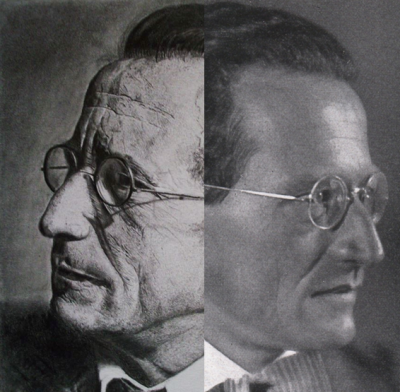

Tomas Tranströmer:

The truth is there on the ground
but nobody dares take it.
The truth lies on the street.
Nobody makes it his own.
[2]

[1] From Apologie de Sebond in the Essais (1580/1589). Translation to English by M. A. Screech, Penguin Books (1987).

[2] From the poem Air Mail in the collection För levande och döda (1989). Translation to English by Don Coles in the collection For the Living and the Dead, Buschek Books (1996).


Next »